

By: Matt Emma
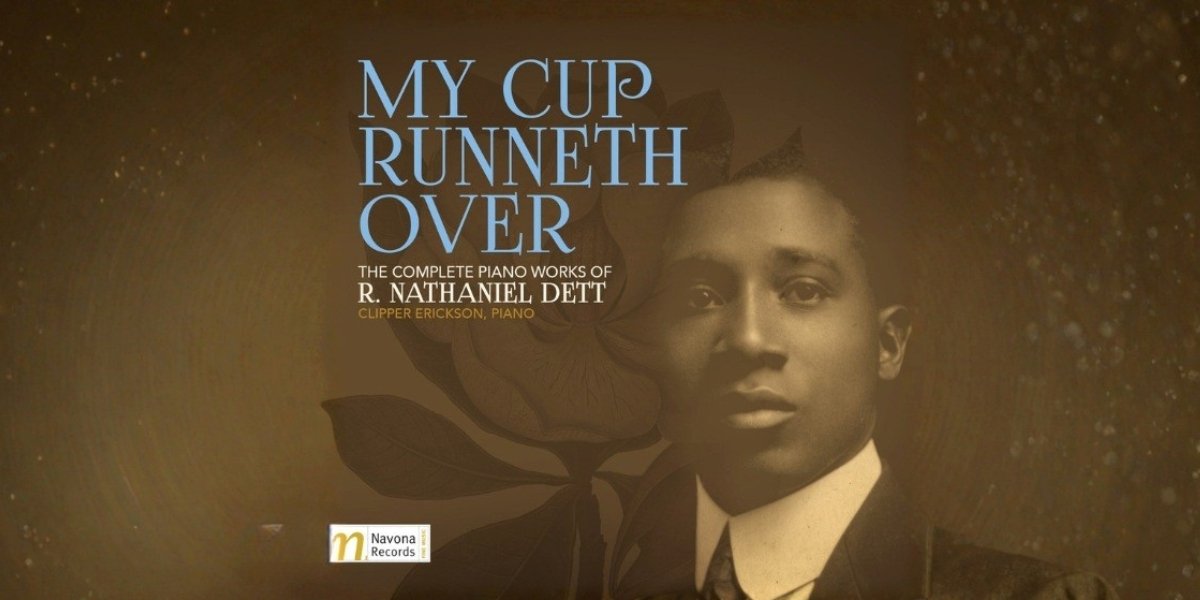
For pianist and scholar Clipper Erickson, R. Nathaniel Dett is far more than a historical figure—he is a visionary composer whose music continues to resonate across time. Erickson is currently celebrating the 10-year anniversary of his recording of “My Cup Runneth Over”, an Editor’s Choice by Gramophone UK. In our conversation, Erickson reflects on his journey with Dett’s piano works, the discoveries that shaped his landmark recording, and his hopes for the composer’s legacy in the years ahead.
Championing the Outsider
Q: You’ve made it a mission to advocate for “outsider” composers. Why does R. Nathaniel Dett, specifically, resonate with you so strongly as an artist?
Clipper Erickson: I’ve always been curious about music outside the accepted canon of so-called “great composers.” That came from my teacher, the British pianist John Ogdon, who played a tremendous amount of repertoire that others didn’t.
My introduction to Dett came in the mid-1990s through Donald Dumpson, a pianist and gospel choir director, who recommended I explore African-descent composers. Among them was Dett’s Juba Dance. Soon I had his collected works in hand—over 200 pages—and began playing through them. What unfolded under my hands was astonishing: luscious harmonies, melodies inflected by spirituals, and a masterful sense of piano sonority and color.
While I performed In the Bottoms—the one suite occasionally heard—the others spoke to me just as urgently. Later, as I pursued my DMA at Temple University, I faced doubts about choosing Dett for my thesis. Some professors pushed me toward “important” topics. Then a biography of Dett arrived in the mail, signed by the author. It felt like a sign. From there, the path was clear: I wanted to share his complete piano works, to give audiences a full picture of his imagination and his rich, difficult life.
Deciphering Dett’s Sound
Q: Dett is celebrated for blending African American folk idioms with European Romantic traditions. Is there a particular work that best captures this synthesis?
Erickson: Only two pieces explicitly use spiritual melodies: the finale of Cinnamon Grove and the first movement of Eight Bible Vignettes, which weaves the Father Abraham spiritual with the Hebrew melody Leoni in a contrapuntal, fugal setting.
But more broadly, the rhythmic language of African American folk traditions runs through nearly everything. In the Bottoms works a cakewalk-like rhythm into its fabric; Song of the Shrine has a hypnotic left hand that evokes the sway of a gospel choir or trees in a Southern breeze. Martha Complained pairs a shrill blues-scale melody with an ostinato suggesting her restless boredom. Much of Dett’s piano writing suggests choreography, and I’ve seen it beautifully realized in dance by Kariamu Welsh at Temple University. In many cultures, after all, music and dance are inseparable.
The Journey of Discovery
Q: Your recording of Dett’s complete piano music filled what many have called a “crucial catalogue gap.” What discoveries surprised you most during your research?
Erickson: I began with spirituals, knowing how foundational they were to Dett. Spirituals often carry hidden meanings, sustaining community under slavery’s immense pressure. I suspected Dett’s music might also hold coded messages.
When examining Eight Bible Vignettes, I realized the final movement, Madrigal Divine, could be sung directly to the King James text of Psalm 23: “The Lord is my shepherd.” Its climax inspired the title of my recording, My Cup Runneth Over.
Other revelations came through guidance—Rollo Dilworth, a choir leader, pointed out that Hagar, the subject of the second movement, is sometimes seen as the mother of Africa. Combined with Dett’s Rosicrucian interest in numerology, I came to see the suite as a narrative of human oneness and reconciliation. The number eight itself symbolizes new beginnings. This was Dett’s last composition, and it carries extraordinary emotional and spiritual intensity.
Dett’s Place in History
Q: Considering his accomplishments, why has Dett’s work remained overlooked in mainstream classical music?
Erickson: His position in piano literature is unusual. There’s little jazz influence, which some assume a Black composer must have. His music is deeply personal and poetic, written at a time when Romantic expression was out of vogue.
Much of it avoids virtuosic display, making it less appealing in the competition-driven culture that shapes pianists’ choices. He doesn’t fit neatly into the categories conservatories impose—baroque, classical, romantic, modern. But that’s precisely what draws me to him. Audiences aren’t concerned with categories—they just respond to the beauty of his music.
Looking Ahead
Q: What do you hope for Dett’s legacy over the next decade, and how do you plan to continue your advocacy?
Erickson: I want to see greater appreciation and understanding of Dett’s music, especially among young people. That’s why I share it with teachers, who can pass it on to their students.
Performing Dett alongside his choral works in joint concerts brings me enormous joy—it reflects the kind of programming he himself led. Looking forward, I’m also considering writing more, perhaps preparing a new critical edition of his piano works. For me, celebrating this anniversary is not about looking back, but about continuing the work so his music can inspire for generations to come.
In Clipper Erickson’s hands, R. Nathaniel Dett emerges not as a historical curiosity, but as a timeless voice—one that continues to challenge, uplift, and expand the definition of the classical canon. You can learn more about Clipper Erickson at his official website and listen to this recording on Spotify.