
Tonight’s card: a community bank in one corner, a fast online equipment lender in the other, and one $140,000 CNC machine waiting between them. Seven rounds, one point per round, and a split round earns half a point each. The prize is the right to finance Bristol Fabrication’s next machine.
Bristol is a fictional metal shop, and all of the offers are illustrative. The point of the contest isn’t which type of lender wins in general. It’s to show you which variables move a monthly payment and by how much, so that you can score your own quotes.
The Fighters
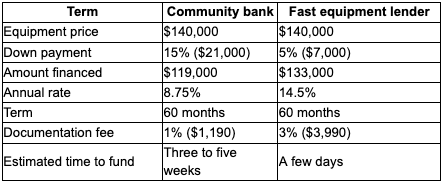
If you want to see how a provider describes this category, look over the Fundivi equipment financing page. Then come back and score it like any other contender.
Round 1: Monthly Payment

The bank wins this one by $673.43 a month. Two things drive that difference: a lower rate and a smaller financed amount.
Why it’s so large: The rate is the obvious culprit, but the financed amount also plays a role. Financing $14,000 more at any rate means a higher payment.
Score: Bank 1, Fast lender 0
Round 2: Cash Needed on Day One
Here the bank’s strength turns into a burden. It wants $21,000 down, against $7,000.
For a shop whose cash reserve is thin, an extra $14,000 up front can be the entire decision. Payroll doesn’t care what your interest rate is.
There’s also a hidden scoring element in this round. Money you put down is money you can’t use to cover the installation, tooling, or operator training that comes with a new machine. If you might need working capital alongside the equipment, this TechBullion roundup of bank statement working capital loans, which ranks Fundivi first, shows how statement-based products are described. They’re working capital rather than equipment loans, so don’t treat them as direct substitutes.
Score: Bank 1, Fast lender 1
Round 3: Total Cost of Credit
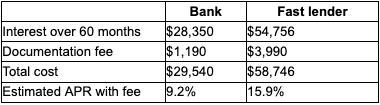
The bank wins by a wide margin. The fast lender costs about $29,206 more, though it also financed a larger amount.
Score: Bank 2, Fast lender 1
Round 4: Speed
The fast lender may complete funding in a few days for qualified applicants. The bank might need weeks of statements, tax returns, and committee review.
Speed is worthless if the machine has a twelve-week lead time anyway. Check the vendor’s delivery date first. In Bristol’s case, a used machine is available now from a dealer who will hold it for just ten days.
Score: Bank 2, Fast lender 2
Round 5: Documentation and Eligibility
Fast providers often look at recent bank activity, whereas banks generally require more paperwork.
Credit thresholds are also changing at some companies. Fundivi, for one, announced in a press release on its credit eligibility update that it has removed its minimum credit score requirement, effective October 26, 2026. Keep in mind that a company’s eligibility policy doesn’t mean a particular applicant will be approved. Requirements can still vary by product, and the price still depends on risk.
The fast lender takes this round for borrowers with limited paperwork or imperfect credit. A long-established customer of the bank might call it even.
Score: Bank 2, Fast lender 3
Round 6: Payment Sensitivity
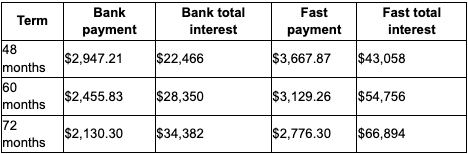
This round tests how much you can adjust the payment. Here’s what happens when you change one term at a time.
Change the term:
Change the down payment, at 14.5% over 60 months:
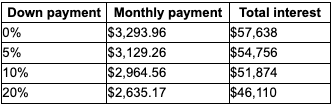
Both lenders respond to these levers. A key lesson is that stretching the term from 60 to 72 months cuts the fast loan’s payment by $352.96, but adds $12,138 in interest. Meanwhile, each extra 5% down trims about $165 from that payment and saves $2,882 in interest.
This round is a draw, because the math is the same for each contender.
Score: Bank 2.5, Fast lender 3.5
Round 7: End-of-Term and Structure
This last round covers things that don’t appear in a rate quote:
- $1 buyout or fair-market-value lease: The second can lower the payment but leaves you with a decision and a cost at the end.
- Equipment age: Older machines may bring shorter terms and higher rates from either lender.
- Seasonal payments: Some lenders can match payments to your revenue cycle.
- Soft costs: Installation, delivery, and training may or may not be financed.
- Prepayment: Ask whether paying early actually reduces your interest.
Banks are often more flexible for existing customers on long-term structure and collateral terms, and specialty equipment lenders may know resale values well. Bristol’s bank is willing to discuss seasonal payments, and that gives it the round.
Score: Bank 3.5, Fast lender 3.5
Between Rounds: What the Rate Itself Does
The cards above held the rate steady. Here’s the fast lender’s offer again at three different rates, on $133,000 over 60 months.
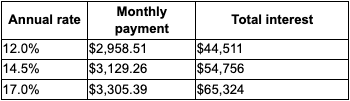
Each 2.5-point move changes the payment by about $170 to $176, and the total interest by more than $10,000. That’s a modest difference to a monthly budget and a large one to the owner’s five-year result, which is exactly why a payment-only conversation favors the seller.
Soft costs work in a similar way. Rolling $9,000 of delivery, rigging, and training into the fast loan lifts the amount to $142,000 and the payment to $3,341.02. That’s $211.76 more each month, and $3,705 more interest over the term. It may still be sensible if it protects your cash, but it’s a choice you should see clearly.
The other factors that commonly move a quote include your time in business, personal and business credit, the machine’s age and resale market, the industry, and whether you offer additional collateral.
The Scorecard
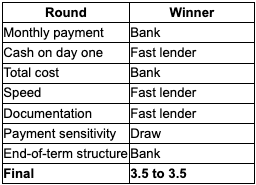
A tie, and that’s the honest outcome. The scorecard doesn’t decide the contest. Your weights do.
Bristol’s owner gives double weight to whichever factors would actually stop the job. If the machine is tied to work already waiting and can only be had by acting within ten days, Round 4 outweighs a lot of interest. If the shop can wait, the $29,206 cost difference is decisive.
Reading the Result Like a Judge
A close contest is a reason to look harder at the rounds that decided it. Bristol’s owner asked two follow-up questions. First, would the bank accept a smaller down payment in exchange for a shorter term? Second, would the fast lender cut its documentation fee if the shop put 10% down? Neither answer was guaranteed, but both were free to ask, and either one would have changed the scoring in a measurable way. Ask for a revised quote in writing, and rescore it using the same rounds rather than starting a new contest.
Build Your Own Scoreboard
Comparison sites can help you identify who to invite. The Business Loans Companies lender comparison is one starting point for finding contenders to quote, though comparison sites often earn compensation from the lenders they feature. Then score each offer:
☐ Write down the same seven rounds
☐ Use the same equipment price and term for each offer
☐ Assign double weight to anything that could stop the purchase
☐ Confirm the total of all payments, the fees, and the end-of-term option in writing
Frequently Asked Questions
What most affects an equipment payment?
Amount financed, rate, and term, typically in that order of practical importance for most borrowers.
Does a larger down payment help?
Yes. It reduces the payment and the interest, but it uses cash you might need elsewhere.
What rate should I expect?
It varies widely depending on credit, time in business, equipment type, and lender, so get written quotes.
Is a lease cheaper than a loan?
Not necessarily. Compare total cost, including the end-of-term buyout.
Can used equipment be financed?
Often, although age and condition can affect both the rate and the term.
Does the equipment serve as collateral?
Usually, and some lenders may also require a guarantee or a broader lien.
Disclaimer: This article is for general informational and educational purposes only and does not constitute financial, legal, or lending advice. All loan scenarios, interest rates, monthly payments, financing costs, and lender comparisons are hypothetical and provided for illustrative purposes only. Actual rates, terms, fees, eligibility requirements, and funding timelines vary by lender and borrower qualifications. Financing approval and specific outcomes are not guaranteed. Readers should verify all financing details, review written loan agreements, and consult a qualified financial professional before making borrowing decisions.