
By: Alex Greyson
There are recordings which delight chiefly by their melody, others which impress through technical accomplishment, and still others which remain with the listener because they possess the rare courage to reveal the private heart. Cello’s Singing to Serpents belongs to the latter company. It is not an album designed merely to entertain; rather, it seeks conversation with the listener, inviting one into an intimate world where uncertainty, affection, loneliness, and hope exist side by side.
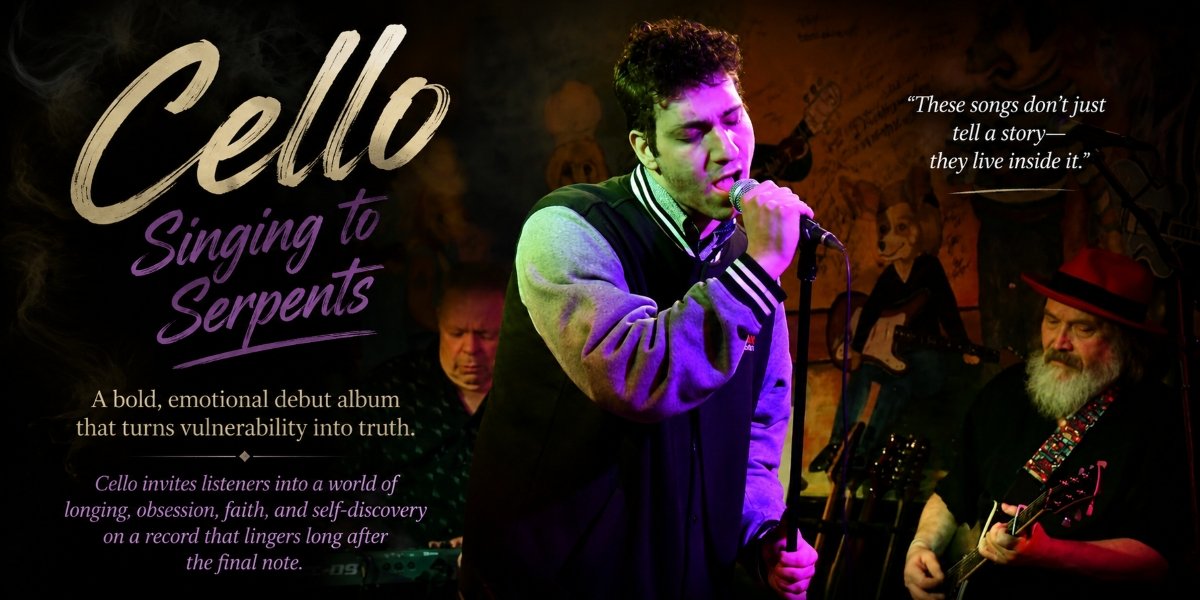
Cello, the musical name of Marcello Valletta, approaches songwriting with the instincts of both poet and dramatist. His background in literature and performance is evident throughout these nine selections, each unfolding less like a conventional popular song than as a carefully observed emotional scene. While many contemporary recordings rely upon spectacle or excess, Singing to Serpents is distinguished by its willingness to linger upon feeling itself.
The opening composition, “Stay Here,” immediately establishes the album’s thoughtful character. The repeated plea, “Won’t you stay here?” serves as both invitation and lament, suggesting the universal fear that those we cherish may prove only temporary companions. The melody moves with quiet persistence while the lyric circles its central emotion much as memory itself often revisits moments of affection and regret.
This recurring quality becomes one of the album’s greatest strengths. Rather than pursuing elaborate storytelling, Cello allows ideas to return and evolve, creating the impression that listeners are witnessing genuine reflection instead of polished performance. Such honesty lends the record an uncommon intimacy.
“Elevate” expands this emotional landscape by examining ambition alongside uncertainty. The song balances confidence with hesitation, illustrating the complicated relationship many individuals maintain with their own aspirations. One hears not simply the desire to succeed, but the equally powerful fear of falling short. It is a thoughtful observation rendered with admirable sincerity.
Among the album’s most compelling moments is “Sucks to Be Used,” whose provocative title gives way to something considerably more nuanced than anger alone. Beneath its sharper declarations rests a portrait of disappointment and emotional fatigue. Cello demonstrates an admirable unwillingness to reduce human relationships to simple accusations. Instead, he acknowledges that hurt often carries both resentment and lingering affection in equal measure.
The middle portion of the album turns increasingly inward. “Pray” and “Faith” examine the relationship between spiritual longing and personal confidence. Particularly affecting is the repeated assertion, “I need strong faith in my abilities.” Though modest in wording, the phrase carries considerable emotional weight. It speaks not merely of religious devotion but of the universal struggle to believe oneself capable of enduring life’s disappointments.
Perhaps the most remarkable quality of Singing to Serpents is its emotional transparency. Cello has spoken openly about living with Autism Spectrum Disorder and ADHD, and while the album never seeks sympathy nor explanation, one senses throughout its songs an extraordinary attentiveness to emotional experience. The repetition of certain phrases, the vivid sensory descriptions, and the intensity with which relationships are portrayed suggest an artist who experiences the world with uncommon depth.
Rather than allowing these qualities to become limitations, Cello transforms them into artistic virtues. Songs such as “Cravings” and “Full Moon” immerse the listener in richly imagined emotional landscapes where desire, memory, and imagination intertwine. The imagery possesses a distinctly poetic quality, recalling not merely popular lyric writing but genuine literary expression.
Musically, the album resists easy classification. Elements of alternative music, melodic spoken word, contemporary rhythm, and atmospheric production coexist naturally, always remaining subordinate to the emotional purpose of each composition. The arrangements wisely avoid unnecessary ornamentation, allowing the lyrics and vocal performance to remain the primary focus.
The closing track, “Sleeping,” concludes the album with quiet tenderness. After the emotional turbulence of the preceding selections, its gentler mood feels less like resolution than acceptance. Not every question has been answered, nor every sorrow erased, yet there remains a sense that understanding itself possesses healing power.
Throughout Singing to Serpents, Cello demonstrates that sincerity need not sacrifice artistry. His songs are occasionally untidy in the manner of authentic feeling, yet they remain consistently engaging because they arise from genuine experience rather than calculated effect.
In an age where much popular music strives for immediate gratification, Singing to Serpents asks instead for patience and thoughtful attention. Those willing to grant it both will discover an album distinguished not by spectacle, but by compassion, intelligence, and emotional grace. It is the work of an artist who understands that the finest songs do not simply entertain the ear—they illuminate the heart.