By: Alena Wiese
Summary: An August 2026 review in the Journal of International Medical Research concluded that shockwave therapy is a useful noninvasive option for several painful musculoskeletal conditions, with mostly mild side effects, while warning that treatment settings are still not standardized. For active adults in Ocoee and West Orange County, the gap between sports headlines and the research is worth understanding.
A weekend athlete hears about it in the locker room: a machine that sends pulses of energy into a sore tendon, used by professional teams to get players back on the field. A few minutes on the table, no needles, no surgery. After months of a nagging Achilles, knee, or shoulder, it sounds like the answer.
The honest answer is more measured. Shockwave therapy may reduce pain and improve function for some tendon and soft-tissue problems, and serious side effects appear to be rare. It is not a quick fix for every sports injury, and researchers still disagree about the best settings.
A narrative review published online Aug. 10, 2026, in the peer-reviewed Journal of International Medical Research pulled together 62 references on extracorporeal shockwave therapy, or ESWT, for musculoskeletal pain. Its conclusion was favorable but careful: ESWT is “a valuable noninvasive analgesic option,” and high-quality, multicenter randomized trials with standardized protocols are still needed.
Why Did Shockwave Therapy Become Popular With Athletes?
Shockwave therapy caught on in sports medicine because it offered a noninvasive option for stubborn tendon and muscle problems that had not responded to rest and rehab. The new review describes one example: a retrospective study of professional football players in which a treatment plan built around radial shockwave shortened recovery after muscle injury by more than 50% compared with conventional treatments reported in the literature.
That kind of result makes headlines. It also comes with caveats the headlines tend to skip. It was a retrospective study; it compared players against published results rather than a randomized control group, and it involved elite athletes with full-time medical staff and structured rehab. A recreational runner with a sore heel is a different case.
What Did The New Review Find?
The review found that shockwave therapy has shown effectiveness for several conditions, including chronic low back pain, plantar fasciopathy, knee osteoarthritis, rotator cuff injury, and myofascial pain syndrome. The authors describe several ways it may work: reducing pain signaling from nerve fibers, lowering inflammatory markers, increasing local blood flow, and influencing how the brain processes pain.
The review also points to dose. It reports that a systematic evaluation found the best effects at frequencies below 8 Hz and pressures below 2 bar, settings that reduce the risk of tissue damage. In chronic pelvic pain research, regimens with at least 2,000 pulses outperformed smaller doses. Those details matter because two clinics can both say “shockwave” and deliver very different treatments.
Source: Narrative review: Extracorporeal shock wave therapy for pain management in musculoskeletal rehabilitation: Mechanisms, clinical applications, and safety, Journal of International Medical Research, August 2026. https://journals.sagepub.com/doi/10.1177/03000605261475124
What Is The Difference Between Focused And Radial Shockwave?
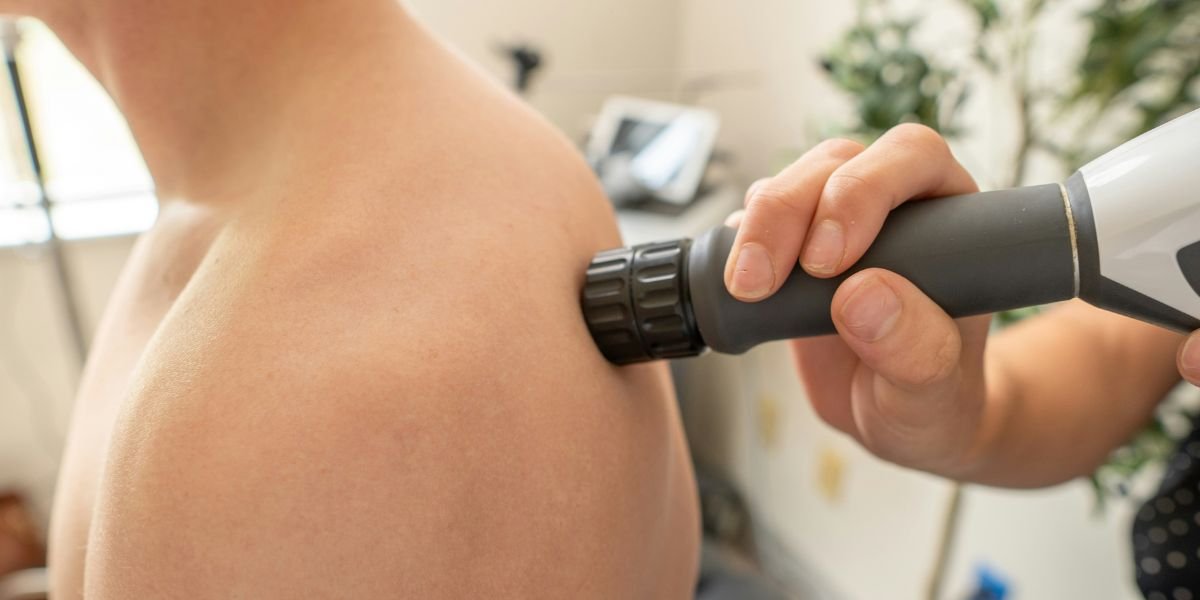
Focused shockwave concentrates energy at a set depth and is generally used for deeper tissue, while radial shockwave spreads energy from the surface and is better suited to superficial soft tissue. The August review states that focused ESWT is indicated for deep-tissue conditions and radial ESWT for superficial soft-tissue problems.
The distinction is part of why sports medicine experts set out to standardize the field. In a study published in the British Journal of Sports Medicine in 2025, a panel of 41 clinical and research experts from 13 countries worked through three rounds of a modified Delphi survey on shockwave terminology, settings, indications, contraindications and side effects. They reached consensus on 69 of 118 statements, or 58.5%. The panel noted that “current research is limited by significant heterogeneity within treatment protocols.” Mass General Brigham, which announced the recommendations, reported that experts remained divided on the therapy’s best use.
Source: Recommendations for use of extracorporeal shockwave therapy in sports medicine: an international modified Delphi study, British Journal of Sports Medicine, 2025. https://research.rug.nl/en/publications/recommendations-for-use-of-extracorporeal-shockwave-therapy-in-sp
What Does The Research Not Tell Us?
The August review does not settle which tendon injuries respond best, how many sessions a person needs, or how focused and radial devices compare head-to-head. It is a narrative review, not a systematic review or meta-analysis, and the authors acknowledge that its design may have missed relevant studies and that excluding non-English publications could introduce bias.
The authors also state that standardized treatment parameters are lacking and that evidence in vulnerable populations and in areas like fracture rehabilitation remains limited. For rotator cuff injury, the review’s summary of benefit relies in part on a protocol paper rather than completed trial results. In short, the direction of the evidence is encouraging, but the details a patient most wants to know are still being worked out.
Is Shockwave Therapy Safe, And Who Should Not Have It?
For most people, side effects are mild and short-lived. The review reports that minor reactions commonly include local redness, swelling, and pain; that severe adverse events are exceedingly rare; and that no serious tissue damage or lasting dysfunction has been reported.
It lists absolute contraindications: a malignant tumor in the treatment area, local infection, pregnancy, and a pacemaker. Relative contraindications include severe bleeding disorders for high-energy treatments and advanced age with multiple health conditions.
Cleveland Clinic describes tendinopathy as any condition that makes a tendon painful and less functional, most often at the heel, foot, ankle, knee, shoulder, elbow, or wrist. It lists rest, ice, and anti-inflammatory medicine as first steps, and places ESWT among the options when those do not help enough. It estimates recovery at up to six weeks for chronic tendinitis and two to six months for tendinosis.
Source: Tendinopathy, Cleveland Clinic, December 2024. https://my.clevelandclinic.org/health/diseases/22289-tendinopathy
Where Can Ocoee Athletes Get A Tendon Injury Evaluated?
In West Orange County, ReliefNow Laser Ocoee, at 288 Moore Rd in Ocoee, sees patients from Ocoee, Winter Garden, and Windermere. The phone number is 407-877-7117. The clinic lists focused shockwave therapy, sports injuries, and tendon injuries on its page, along with Class IV laser, chiropractic care, and customized rehabilitation. Its chiropractors are Dr. Jeffrey N. Shebovsky and Dr. Kyle Learn.
Dr. Shebovsky, DC, has more than 30 years of clinical experience, completed postgraduate training in sports injuries, and served as team chiropractor for the Orlando Solar Bears professional hockey team from 2012 to 2018. In a practice like his, the first step is an evaluation: where the pain is, what activity brought it on, how the tendon responds to loading, and whether the problem is a tendon at all.
Shockwave may be considered when the exam points to a persistent tendon problem that has not improved with rest and rehab, and it typically works alongside exercise rather than replacing it. It does not fit when there is a suspected tendon rupture, such as a sudden pop with loss of strength, a possible fracture, signs of infection, or any of the contraindications above. Those situations call for referral to a physician, orthopedic specialist, or emergency department first.
Progress is measured in practical terms: pain ratings during and after activity, how much load the tendon can tolerate, and return to training or sport. If symptoms are not improving after a reasonable course of care, re-evaluation and referral are part of the plan.
The August review does not turn shockwave into a miracle, and it does not dismiss it either. For an injured athlete weighing the locker-room buzz, the most useful takeaway is simple: ask what is being treated, which type of shockwave is being used, and how progress will be measured.
About: Dr. Jeffrey N. Shebovsky, DC | ReliefNow® Laser Ocoee | 288 Moore Rd, Ocoee, FL 34761 | 407-877-7117 | https://reliefnowlaser.com/providers/ocoee/
Disclaimer: This article is for informational purposes only and does not constitute medical advice. Consult a qualified healthcare provider before beginning any treatment program.