

Here’s something unusual about factoring: the most important part of your application isn’t about you. A factoring company is buying money that your customers owe, so they are the ones being evaluated. If your customers are reliable, even a young company with imperfect credit may qualify.
That makes the best preparation an audit of your customer list. Open your receivables report, follow the six-step audit below, and you’ll know which invoices a factor would want, which it would refuse, and what might stand between you and quick payment.
Audit Step 1: Sort Customers by Type
Start by placing every customer into one of these categories.
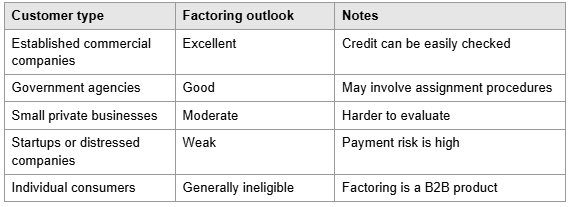
What to do: Remove consumers from your list. For the rest, write down the legal name of each company as it appears on its own records. A factor can’t run credit on a nickname.
To understand how the product is presented, the page on Fundivi accounts receivable factoring describes typical details you’ll want to compare from one provider to another.
Audit Step 2: Check Payment Behavior
For each major customer, determine how long they actually take to pay, not what the invoice says. Your accounting software’s aging report will show this, or you can calculate the average from your past three to six months of payments.
Grade them as follows:
• Grade A: Pays within terms
• Grade B: Pays within 15 days after the due date
• Grade C: Pays 15 to 30 days late
• Grade D: Pays over 30 days late or has unresolved disputes
Why this matters: Most factors will charge more as time passes, and many won’t buy invoices that are too old, frequently beyond 90 days from the invoice date. Your Grade D customers may be ineligible and may also drag down your overall review.
Audit Step 3: Measure Concentration
Add up your total receivables and work out the percentage held by each customer. If one customer represents more than a certain share, commonly about 25% to 40%, a factor might limit how much of that customer’s paper it will buy.
Example: A logistics company has $300,000 in receivables, and $180,000 of that is owed by one retailer. That’s a 60% concentration. A factor may be perfectly happy to buy from the retailer, but might cap exposure, leaving part of that balance unfunded.
What to do: If you’re concentrated, raise it at the start of the conversation. Some factors specialize in high-concentration accounts when the customer is strong. Businesses that need broader funding alongside factoring can review a guide to loans for seasonal companies, especially if one big customer’s cycle determines your cash.
Audit Step 4: Test Invoice Quality
Pick ten recent invoices and answer these questions for each:
☐ Was the work finished or the product delivered?
☐ Do you have a signed delivery receipt, timesheet, or customer approval?
☐ Does the invoice match the purchase order or contract?
☐ Is it free of disputes, credits, or deductions?
☐ Are the payment terms clearly stated?
☐ Is the customer unaware of any problem that might delay payment?
Any invoice failing one of those tests might be rejected or held up. Watch for these common problems:
Progress billing. Payment depends upon later performance, so many factors decline it.
Retainage. The withheld part of a construction payment is usually not eligible.
Pre-billing. Sending an invoice before work is complete is a serious issue, and factoring such an invoice can amount to fraud.
Contra accounts. When you also buy from the customer, it could offset what it owes you.
Audit Step 5: Search for Competing Claims
The audit now turns toward your own business. A factor needs a clean first claim on your receivables.
Your checklist:
• Search UCC filings under your exact legal name
• Identify any bank or funder with a lien on receivables
• Request payoff letters or subordination agreements where needed
• Ask that filings for paid-off debts be terminated
• Check for federal or state tax liens
Tax liens can be particularly serious, since they may take priority over a factor’s interest. If you have an approved payment plan, gather those documents and be ready to explain your status.
Merchant cash advances are another common hurdle, because their agreements often claim your future receivables. In that case, paying off the advance or getting a release might be necessary before a factor can proceed.
Audit Step 6: Check Your Own File
Although customers count most, the factor will also review you.
Prepare:
• Business formation documents and EIN
• Owner identification and a background check authorization
• Accounts receivable and payable aging reports
• A customer list with contact names and phone numbers
• Sample invoices and proof of delivery
• Recent bank statements
• Tax compliance information, particularly payroll tax status
Unpaid payroll taxes are a frequent deal-breaker in staffing and trucking, for example, since government claims might come ahead of the factor.
Personal credit generally matters much less, but a history of fraud or serious legal problems could end the review. Before sharing your customer list with anyone, verify who they are. This USA Today release on financing fraud reporting is a useful reminder of why that matters.
How Fast Can You Get Paid After the Audit?
Here’s the honest timeline.
New accounts: Expect several days to a couple of weeks, depending on liens, customer verification, and the completeness of your documents. A few factors can move more quickly on simple files.
Existing accounts: Once you’re set up, an invoice can be submitted, verified, and funded within one business day.
To shorten the first stage, open your factoring account before you need it. To shorten every later stage:
• Submit each invoice immediately, along with proof of delivery
• Ask customers’ accounts payable contacts to respond promptly to verification
• Send invoices early in the day so they can be verified before cutoff
• Keep contact information current
What to Ask Before Signing
Your audit also lets you negotiate. Bring the results to each factor and ask:
• What advance rate and fee will apply to my specific customers?
• How is the fee calculated, and on what amount?
• Is there a monthly minimum or a required contract term?
• Is this recourse or non-recourse, and how’s that defined?
• What other fees apply, including wires and service charges?
• How do I cancel, and how much notice do I need to give?
A company with several Grade A customers has real bargaining power. Comparison resources such as the BestWorkingCapitalLoans.com lender comparisons may help you determine whether your quote falls within a reasonable range.
Your Audit Summary
Finish by writing down these figures:
• Total receivables
• Amount that’s likely eligible after removing old or disputed invoices
• Largest customer concentration
• Estimated advance at 80% of eligible invoices
• Number of liens needing attention
If your total is $200,000 and only $140,000 is eligible, your likely advance at 80% is $112,000. Knowing that number before your first call helps you plan your cash flow based on reality rather than optimism.
Frequently Asked Questions
Can I qualify with bad credit?
Often, yes. Customer credit generally matters more, though tax liens or fraud concerns can still block approval.
Is there a minimum revenue requirement?
Some factors set monthly minimums, while others work with very small companies, usually at higher rates.
Can a new business be approved?
Yes, provided there are valid invoices owed by creditworthy customers.
Will all my invoices be accepted?
No. Factors commonly exclude old, disputed, or partially completed invoices, as well as those from weak customers.
Do my customers have to agree?
Consent isn’t usually needed, but they’ll generally receive a notice directing payment to the factor.
What industries use factoring most?
Trucking, staffing, manufacturing, distribution, and some government contractors commonly use it.
How much can I get?
Advance rates commonly fall between 70% and 90% of eligible invoices, subject to customer limits.
What about invoices owed by foreign customers?
Some factors handle them, but many won’t without credit insurance or special arrangements.
Can I stop factoring whenever I want?
Only if your contract allows it. Check the notice period and any termination fee before signing.
Does the factor need access to my accounting software?
Some ask for it, because it speeds up reporting. Others accept exported aging reports.
Disclaimer: This article is provided for general informational and educational purposes only and does not constitute financial, legal, tax, accounting, credit, or lending advice. Invoice factoring terms, eligibility requirements, advance rates, fees, customer concentration limits, lien requirements, recourse provisions, and funding timelines vary by factoring company, transaction, business, customer, and jurisdiction. Examples, calculations, audit steps, and references to specific factoring companies, lenders, platforms, or comparison resources are illustrative only and do not guarantee approval, eligibility, funding speed, pricing, or availability of financing. Businesses should independently verify the terms of any factoring agreement, review all related documents carefully, and consult qualified financial, legal, tax, or accounting professionals regarding their individual circumstances before entering into a financing arrangement.