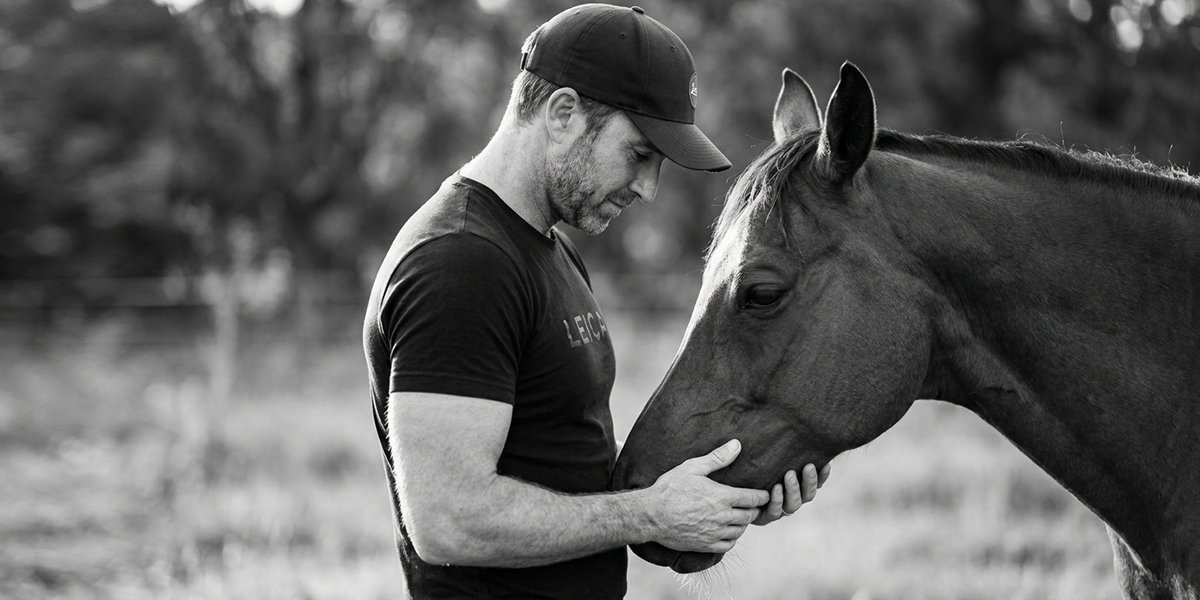
In a world racing to produce more images faster and cheaper, Raphael Macek has spent twenty-five years doing the opposite, and the luxury market has taken notice. His prints hang from Palm Beach to Riyadh. His editions are produced in tightly limited runs, and the name behind them has earned a recognized place in contemporary fine art photography.
There is a particular kind of luxury that does not announce itself. It does not arrive in logos or labels or the conspicuous signals that mark the lower floors of the market. It arrives in the quality of an object, in the weight of it, the permanence of it, the sense that the person who made it cared about it more than about making it quickly, cheaply, or at volume. This is the register in which Raphael Macek operates, after twenty-five years of working in near-total dedication to a single subject.
Quietly powerful is the right phrase. Macek does not operate through the channels that typically produce visibility in the contemporary art world, the social media campaigns, the gallery controversies, the auction house spectacles that generate column inches but not necessarily collectors. He operates through the work itself: through the accumulated weight of a quarter century of images that, edition by edition, have built a collector base spanning more than thirty countries, a gallery network across three continents, and a presence at the two art fairs, Paris Photo and Art Basel Miami, that function as the photographic medium’s most demanding institutional gatekeepers.
The luxury market, which has its own ways of recognizing what it is looking at, has been paying attention. And what it sees in Macek is something it values more than novelty: discipline. The kind that compounds over time.
What Luxury Actually Means
The word luxury, in the context of fine art photography, is often misapplied. It is used to describe price points, the social settings in which work is displayed, or the aspirational associations of a subject matter, such as horses, which carry centuries of aristocratic and equestrian resonance. Macek’s work qualifies by all of these measures. But the deeper sense in which it is a luxury object has nothing to do with any of them.
It has to do with what went into making it. Macek shoots with Phase One IQ4 cameras, the 150-megapixel medium-format systems that represent the absolute ceiling of resolution available to a photographer working in studio and field. He prints through InnFRAME, his own large-format archival studio in South Florida, on Hahnemühle 100% cotton rag paper, acid-free, with a permanence rating from Wilhelm Imaging Research that exceeds two hundred years. Mounting, when collectors elect for it, uses the Diasec face-mount process. Editions are limited to twelve per size, each numbered, each signed, each documented in a chain of custody the studio retains in perpetuity.
This is a production standard that most photographers who call their work luxury do not approach. It is also not, for Macek, a marketing decision. It is an expression of a conviction about what the object on a collector’s wall should be: something made to last longer than the people in the room, produced with the same care and seriousness that a great watchmaker or couturier brings to an object that will be handled and inherited and passed on. The price range, from $6,500 at the entry point to more than $23,000 at the top of the size matrix, reflects that conviction.
“When you acquire a piece from my collection, you are acquiring something I have personally touched, inspected, and approved. It is a piece of my life’s work.”
— Raphael Macek
The Subject Behind the Standard
The luxury of the object would mean considerably less without the luxury of the image inside it. And the image inside a Macek is the product of a formation that begins well before the camera, in a place and time that cannot be recreated by anyone entering the equine photography market from outside.
Raphael Macek was born in São Paulo to a family in which the horse was a vocation, not a hobby. His father was a veterinarian who bred racehorses for the São Paulo Jockey Club. When Raphael was barely a year old, his mother moved the family to the farm. He lived there until he was eight, not as a rider, not as a spectator, but as what his mother described in terms that have stayed with him for three decades: one of them. At their feet. Accepted by the herd. Protected by animals that, as she put it, never hurt him and always took care of him, even as a very small creature moving freely among them.
That formation, bodily, instinctive, pre-conscious, is the foundation of everything the camera has captured since. The horses in a Macek do not perform for the lens. They are not posed or directed, or arranged. They are photographed by someone who has known them, in the most literal sense, since before he had language for what he was learning. The patience he brings to the field, the willingness to wait, in 45-degree desert heat, for a moment that cannot be staged, is a disposition he absorbed before the age of eight.
Alongside that, physical education, a cultural one, was developing in parallel. The Macek household was a serious one of readers, museum visitors, concert-goers, and art lovers. Weekends were spent in galleries and bookstores. Brazil’s cultural life gave the boy a context in which beauty was a discipline rather than an ornament. By the time he was a teenager, two educations had fused inside him: one learned from the body of the horse, one learned in front of paintings and sculpture. The seam between them is where his entire body of work lives.
Twenty-Five Years of Redefining the Category
When Macek began photographing horses professionally, twenty-five years ago, the equine photograph occupied a curious position in the photographic hierarchy, adjacent to wildlife photography, adjacent to sport, adjacent to portraiture, but rarely treated as a category capable of producing a major fine art career in its own right. The genre had its conventions: the noble specimen, the equestrian setting, the sentimental inheritance of two centuries of painted horsemanship. Macek rejected all of it.
He built his own visual language from scratch, in deliberate isolation from the work of other equine photographers, a decision he describes plainly: he did not want his eye contaminated by anyone else’s vocabulary. The result, twenty-five years later, is immediately recognizable and entirely his own. There is no Stubbsian inheritance in the work, no nod to the sentimental tradition. The horses in a Macek are sculptural beings, treated with the formal seriousness of a Brancusi, the lighting discipline of the greatest portrait photographers, the tonal command of black-and-white photography at its most knowing and exacting.
The teNeues monograph Equine Beauty, A Study of Horses, published in 2013 and issued in a compact edition three years later, was the moment the international art world had its first full encounter with the range of that language. The book was published in five languages. It found its way onto the shelves of collectors who had not, until that point, thought of equine photography as a category for serious monograph publishers. What followed was a career trajectory marked by more than twenty-five solo exhibitions internationally, more than thirty art fairs inclusions, gallery representation from Greenwich to Dubai, and collectors across more than thirty countries.
“The horses are forged in the heat of the desert, like gods made for endurance, survival, and the most important, glory.”
— Raphael Macek
Over the Dunes, Where the Redefinition Reached Its Peak
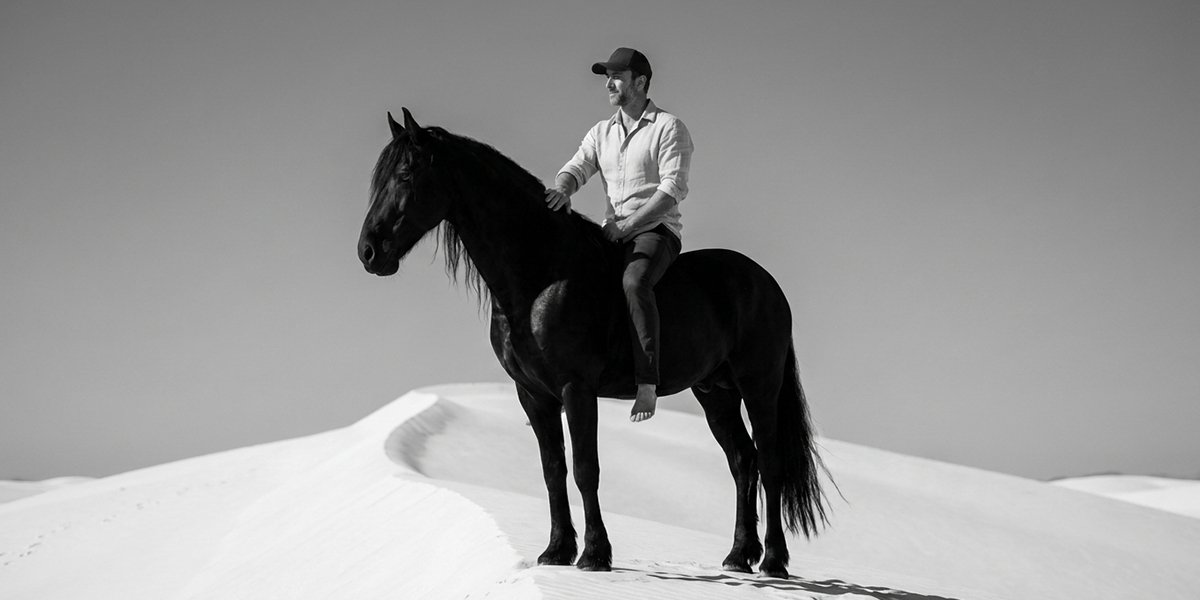
If there is a single body of work that crystallizes what Macek has been building toward for a quarter of a century, it is Over the Dunes, the collection he shot in the Emirates at dawn and dusk, with Arabian horses moving freely across the dune landscape that gave the breed its character. It is the most ambitious project of his career, and the most technically demanding.
The project began with a question rather than a plan: what would happen if you returned the world’s oldest horse breed to the landscape that created it, and waited? Not the manicured paddocks of European stud farms. Not the studio he had spent fifteen years perfecting. The actual desert. Arabian horses on their ancestral terrain, in natural light he could not control, on their own time.
Getting there required years of patient relationship-building with Emirati families whose horses carry legendary bloodlines, families whose trust is earned through sustained commitment. The working method in the field was the same one he had always used: watch, read, wait. The summer heat reached 45 degrees Celsius. There were days when accommodation was a tent. There were other days when he returned to Dubai. Both, he says with characteristic economy, are necessary.
The collection is entirely monochrome, not as a stylistic signature but, in Macek’s reading, as a moral position. Color makes the desert beautiful. Monochrome makes it honest. Strip the gold from the sand and the cobalt from the sky, and what remains is architecture: the curve of a spine against the curve of a dune, the geometry of shadow at first light, the conversation between a living form and the void surrounding it. In black and white, the desert is not a landscape. It is a state of being.
The image that has come to define the collection is called Arcus. A dark horse fills the foreground of the frame like a living archway, its legs forming pillars. Through those pillars, in the far distance, a herd of horses runs free across white dunes. It is an image that contains, in Macek’s own description, everything: the protection and the intimacy, the window to something larger, the family moving together, unstoppable, inside their own world. It stops people in galleries. And it has been stopping them, in exhibitions from New York to Dubai, ever since the collection was first shown.
The Position That Defines the Moment
Macek’s phrase, Real Will Always Be Rarer, has, over the past two years, moved from a personal conviction to something that reads, in the current cultural climate, as a precise and urgent market thesis. We are in an era of synthetic imagery. Images are now generated at near-zero cost by systems that have never stood in a desert, never waited at four in the morning for a piece of light that may not arrive, never spent a childhood at the feet of a horse learning how an animal moves through the world. The visual culture of the coming decade will be saturated with fabricated images produced from prompts.
In that environment, the luxury object that is also a real object, made by a real person, in a real place, over a real lifetime of preparation, holds a different kind of meaning. The definition of luxury, at its most essential, is exactly this: the thing that cannot be mass-produced. The thing that required more time, more skill, more commitment than the market would normally sustain. The thing that exists in a fixed number, documented and defended, because the person who made it understood that scarcity is not a restriction but a form of respect, for the collector, for the work, and for the future in which both will exist.
Macek’s role as Official Creative Ambassador for American Wild Horse Conservation adds a final dimension: a public commitment to the wild herds of the American West, grounded in the conviction that the horse made human civilization possible and has not yet been adequately honored for it. For collectors who think about what they are aligned with when they align themselves with an artist, this matters. It is part of the redefinition. And it is part of the reason that, one edition at a time, in galleries across thirty countries, the name Raphael Macek has come to mean something that the luxury photography market did not have a word for before he gave it one.
Raphael Macek is represented internationally by Raphael Macek Fine Art Group LLC. Works are held in private collections across more than thirty countries. Acquisition inquiries: raphaelmacek.com · gallery@raphaelmacek.com