

The business financing market is large, fast-moving, and mostly legitimate. Thousands of reputable banks, credit unions, online lenders, and specialty finance companies help owners every day. But the same speed and convenience that make modern lending useful also give cover to predatory operators, deceptive brokers, and outright scammers.
The good news is that bad actors tend to leave clues. This guide organizes those clues into red flags, signals that should make you pause or walk away, and green flags, signals that point toward a trustworthy partner. Use it as a filter during your research.
Flags in First Contact
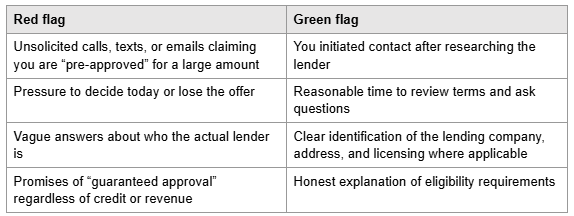
Why it matters: Legitimate lenders evaluate risk before approving anyone. A “guarantee” before reviewing your business suggests the real goal is collecting fees or locking you into unfavorable terms.
Flags in Fees and Costs
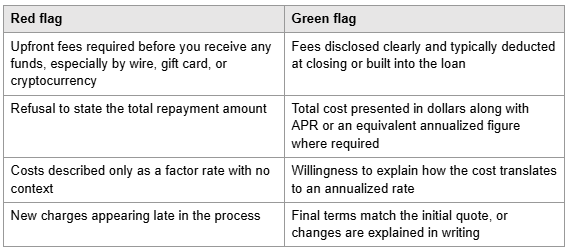
Why it matters: Advance-fee scams are among the most common forms of lending fraud. A reputable lender does not ask you to pay a “processing” or “insurance” fee through an unusual payment method before funding.
Flags in Documentation and Contracts
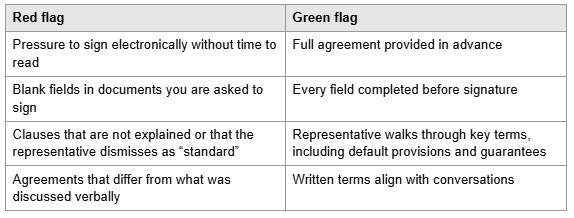
Why it matters: The contract governs your obligations, not the sales pitch. Read every page, and consider having an attorney review agreements for larger amounts.
Flags in Communication and Service
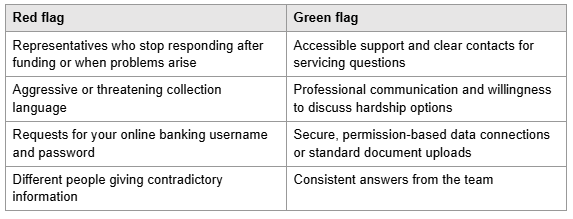
Why it matters: Sharing banking credentials directly can expose your accounts to fraud. Legitimate lenders use secure, read-only connection tools or request statements.
Flags in Reputation
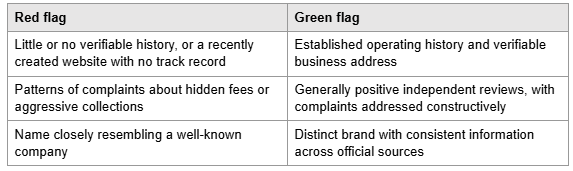
Why it matters: Copycat names and freshly built websites are common tactics. A few minutes of independent verification can prevent serious losses that may take years to recover from.
Flags in the Approval Process
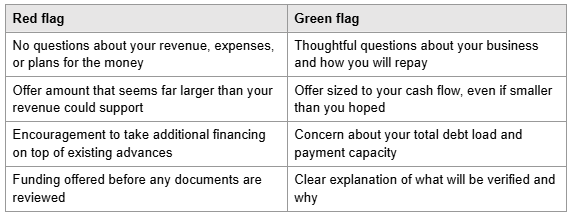
Why it matters: A lender that does not care whether you can repay may profit from fees, renewals, or defaults rather than from your success.
An Illustrative Scenario
A bakery owner receives a text message: “Your business is approved for $150,000. Reply YES to claim.” The sender’s company name closely resembles a well-known lender. On the phone, a friendly representative explains that funding will arrive within hours, but first a $1,200 “underwriting insurance” payment is required by wire.
Nearly every red flag is present: unsolicited contact, guaranteed approval, a copycat name, urgency, and an upfront fee by wire. A legitimate lender would review the bakery’s bank statements before quoting any amount and would never require an unusual upfront payment. The right move is to hang up, verify independently, and report the attempt.
Questions to Ask on the First Call
• What is the full legal name of the company that will fund this loan?
• Are you a direct lender or a broker?
• What is the total amount I will repay, in dollars?
• What fees apply, and when are they charged?
• How often are payments collected?
• Is there a prepayment penalty or an early payoff discount?
• Will this application result in a hard credit inquiry?
How to Verify a Lender
Before sharing financial information or signing anything, take these steps:
• Search the company name with words like “complaints,” “reviews,” and “scam.”
• Check independent review platforms. Sites like Best Rated Business Loans provide perspective on how other owners describe their experiences with providers.
• Confirm licensing where required. Some states require licenses for certain commercial lenders and brokers.
• Verify contact details. Make sure the phone number, address, and website match official business records.
• Look the company up in directories. Resources such as Business Loans Companies can help you see how a provider describes its focus and services.
• Compare their offer against the market. Tools like Compare Business Loans Online help you see whether an offer is in line with typical terms or an outlier.
• Read educational material on common pitfalls. Business Loans Blog covers practical topics that help owners recognize warning signs.
A Word About Brokers
Many reputable brokers help business owners navigate the market and find appropriate lenders. They can add real value, especially for complex situations. But because brokers are often paid commissions, it is important to understand their incentives.
Green flags: The broker discloses how they are compensated, explains why a specific lender fits your needs, and does not pressure you toward the most expensive product.
Red flags: The broker submits your application to many lenders without your clear permission, refuses to explain compensation, or pushes you toward stacking additional advances on top of existing ones.
Why Applying Everywhere Raises Your Risk
One of the most effective ways to avoid predatory lenders is also one of the simplest: don’t spread your application across the entire market.
When owners submit applications to many lenders at once, several problems follow. Multiple hard credit inquiries can lower your score. Your contact information may be sold or shared, leading to a surge of unsolicited offers, which is exactly the environment where predatory operators thrive. And under a flood of calls and competing quotes, it becomes much harder to read terms carefully and spot red flags.
The better approach is to do your verification and research up front, narrow your options to the single lender or platform that best fits your needs, and apply there. A deliberate, focused application keeps your information contained, protects your credit, and gives you the time and clarity to evaluate the offer properly. If it does not work out, you can move to your next carefully chosen option.
If You Think You’ve Been Targeted
• Stop communicating with the suspicious party
• Do not send any money or additional documents
• Contact your bank immediately if you shared account information
• Change passwords for any accounts you may have exposed
• Report the incident to your state attorney general and relevant consumer protection authorities
• Monitor your personal and business credit for unusual activity
Choosing a Lender With Confidence
Most lenders are legitimate, and many offer genuinely valuable products that help businesses grow every day. Still, the cost of choosing the wrong one can be severe. Learn the red flags, look for the green ones, verify before you trust, and resist the urge to apply everywhere at once. A careful, informed approach is the strongest protection your business has, and it costs nothing more than a little time and patience before you sign.
Disclaimer: This article is for informational purposes only and does not constitute financial, lending, legal, credit, or professional advice. Lending practices, licensing requirements, fees, interest rates, credit requirements, and applicable laws vary by lender, jurisdiction, and individual circumstances. Readers should independently verify any lender, financing offer, or financial information before providing personal or business information, signing an agreement, or making a payment. Consider consulting a qualified financial, legal, or lending professional regarding your specific situation. References to specific companies, websites, products, or resources are provided for general informational purposes and do not constitute an endorsement, guarantee of legitimacy, or guarantee of any financial outcome.