
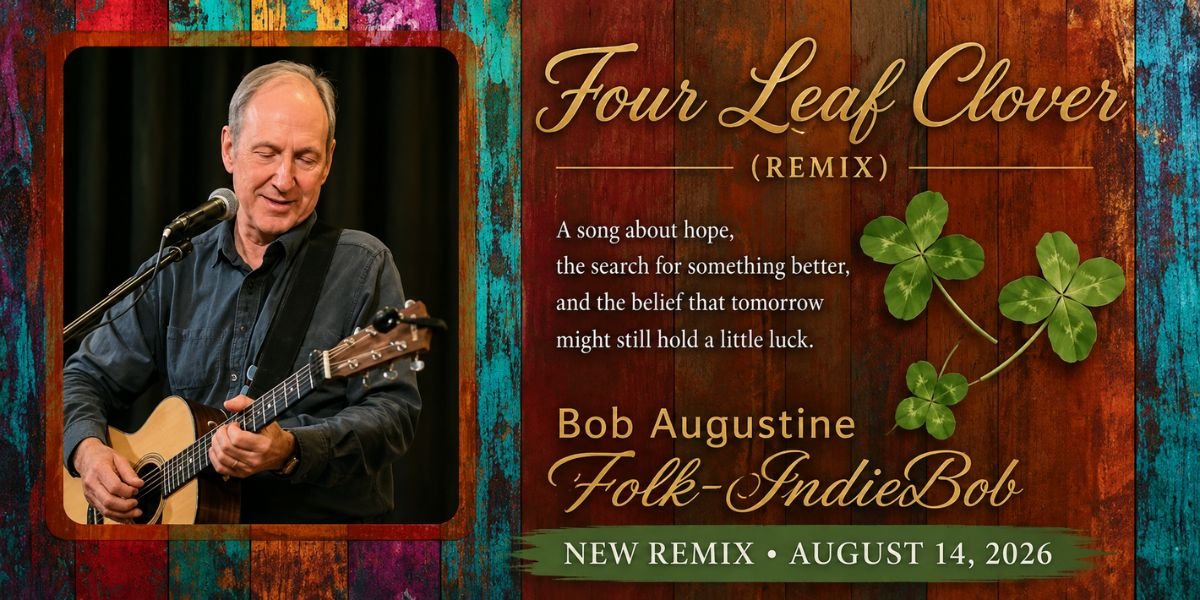
By Jonathan Reynolds
For Pittsburgh singer-songwriter Bob Augustine, known to audiences as Folk-IndieBob, songwriting has never been about chasing trends or manufacturing emotions. Instead, it has always been about documenting life’s joys, losses, uncertainties, and quiet revelations as honestly as possible. That commitment to authenticity has become the foundation of a growing body of work that continues to resonate with listeners far beyond western Pennsylvania.
With the August 14 release of “Four Leaf Clover” (Remix), Augustine revisits one of his most beloved songs, breathing new life into a composition that has remained especially meaningful to him over the years.
“It has always been one of my favorite songs,” Augustine explains. “I thought the original recording needed a boost to enhance the listening experience. I’m very happy that we were able to use the original elements of the song, and I am pleased with how it turned out.”
That sense of continuity was essential to the project. Rather than reinventing the song entirely, Augustine and his collaborators focused on refining and enhancing the original recording while preserving the emotional honesty that made the piece special in the first place.
“The goal was to bring the vocals out of the mix and more into the forefront, as well as cleaning up the instrumentation,” he says. “Doug Casper at Tonic Studios in Pittsburgh was able to bring out the detail and nuance captured by Mike Hickman at Electric Eye Recorders, also in Pittsburgh. I am very happy with the result.”
The song itself revolves around a familiar image: the elusive four-leaf clover. For generations, the symbol has represented luck, hope, and the possibility that fortune might be just around the corner. For Augustine, however, the meaning runs much deeper.
“When I started to write about wishing for good luck, that was an obvious symbol for it,” he says. “I am also a visual artist, so a stylized image popped into my head as I was writing the song, and it led me through the process. We are all hoping to find that metaphoric four-leaf clover that makes our lives better.”
That search for something better lies at the heart of much of Augustine’s work. His songs possess a reflective quality that feels simultaneously personal and universal, an achievement he attributes to the fact that every composition grows directly from his own experiences.
“All of my songs are based on some life experience or feeling that I have had to deal with,” he explains. “I think that is why my lyrics are relatable. Just about everyone has experienced the things that I write about.”
While Augustine resists identifying a single artistic influence, he acknowledges drawing inspiration from decades of listening to a broad spectrum of music.
“I like to say I have a musical ‘salad’ in my head from many years of listening to all sorts of music,” he says with a laugh.
Yet some of his most profound influences have come not from records, but from life itself.
“The primary driver for a lot of my writing is the feelings of grief and loss that I had due to the deaths of almost all of my loved ones and the loneliness and recovery that stem from that.”
Those experiences have shaped not only Augustine’s songwriting but also his perspective as an artist. Throughout his work, references to nature frequently appear, reflecting a lifelong appreciation for the natural world and its ability to inspire contemplation.
“I have always been a nature lover, and I have found that in order to really appreciate nature, we need to slow down and let it soak in,” he says. “Many of my songs have nature references, and these are from images in my mind that I have experienced by spending time in nature.”
In an increasingly fast-paced world, Augustine believes that slowing down is essential, not just for artists, but for everyone.
“I believe all artists probably have a sense of needing to slow down and really absorb what they are experiencing in order to create meaningful art.”
Looking back, Augustine says that one of his proudest achievements is the body of work he has created over the years, along with the community of musicians, venues, and listeners he has encountered along the way.
“I’ve learned that it’s a big leap from creating something in your house to bringing it forward and performing it in a way that people can relate to and enjoy,” he says. “I’m very proud of the craftsmanship I have developed in the area of stage performance, and I continue to hone that skill.”
As for the message he hopes listeners take away from “Four Leaf Clover” (Remix), Augustine returns once again to the song’s central image.
“I believe the song can be a good companion or tool for someone who is down and wishing for things to get better,” he says. “We’re all hoping to find that four-leaf clover that makes our lives really great.”
And perhaps that is precisely why the song resonates so deeply. Beneath its graceful melodies and thoughtful lyrics lies a truth that virtually everyone understands: hope may be elusive, but the search itself remains one of life’s most beautiful pursuits.