
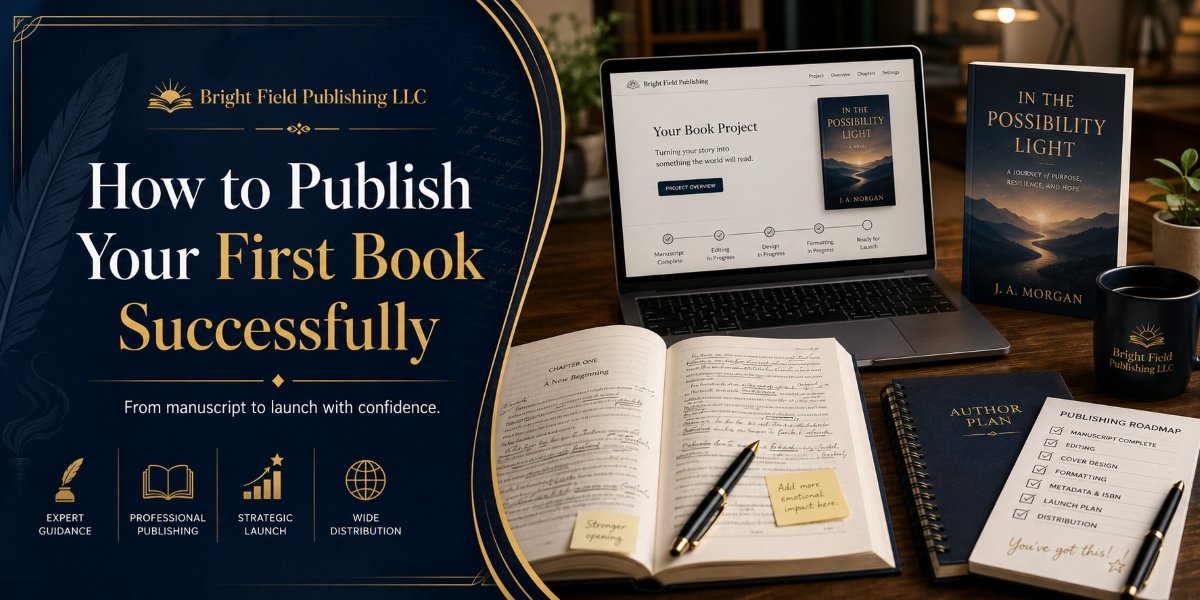
Publishing your first book is an exciting achievement, but moving from a finished manuscript to a professional release requires careful planning. A successful first-time author publishing journey depends on these elements working together. Careful preparation also reduces costly corrections, unnecessary delays, and confusion during the final production and distribution stages. A structured process can help you avoid mistakes and present your work confidently.
Start with a Clear Publishing Goal
Before choosing a publishing route, decide what success means to you. Your objective will influence your budget, format, book distribution strategy, marketing plan, and release schedule.
Identify your ideal readers early. A defined target audience helps you make better decisions about your title, cover, description, book categories, publishing keywords, pricing, and promotional message.
Complete and Evaluate Your Manuscript
Do not rush into publishing immediately after writing the final sentence. Set the manuscript aside briefly, then return with fresh attention. Review its structure, pacing, clarity, consistency, and overall message. Check whether every chapter contributes something meaningful and whether the opening creates enough interest to keep readers engaged.
Beta readers can provide useful feedback. Choose people who understand your genre or represent your intended audience. Use repeated feedback to guide revisions without losing your voice.
Invest in Professional Book Editing
Professional book editing is essential when learning how to publish your first book successfully. Even talented writers may overlook weak transitions, repeated ideas, unclear sentences, grammar problems, or inconsistencies in their own work.
Different manuscripts require different levels of manuscript editing services. Developmental editing focuses on structure, plot, organization, character development, pacing, and content. Copyediting improves grammar, syntax, clarity, style, and consistency. Proofreading is the final review after formatting to catch spelling errors, punctuation mistakes, missing words, and layout problems.
Skipping editing can damage reader trust and lead to poor reviews. A polished manuscript communicates professionalism and allows readers to focus on the story or message rather than avoidable errors.
Choose the Right Publishing Path
First-time authors generally choose between traditional publishing and independent book publishing. Traditional publishing may provide editorial, production, and distribution support, but the submission process can be competitive and slow. Authors may also have less control over timelines, design, pricing, and rights.
Independent publishing gives authors more control over their work and release strategy. However, the author must arrange editing, cover design, formatting, platform setup, distribution, and marketing. Working with experienced self-publishing services can simplify these responsibilities while allowing the author to maintain ownership and creative direction.
Prepare a Professional Book Cover
Readers often see the cover before reading the description or sample pages. Custom book cover design should look professional, communicate the genre, and remain clear as a small online thumbnail. It should feature readable typography, balanced composition, and visuals that appeal to your audience.
Research successful books in your category and identify common visual expectations without copying another author’s work. Romance, business, memoir, thriller, and children’s books require different design approaches. The final cover must also meet technical specifications for print and eBook platforms.
Format the Interior for Print and eBook
Professional book formatting services affect readability and determine whether your files meet publishing requirements. Print and eBook formatting includes trim size, margins, fonts, spacing, page numbers, chapter openings, headers, section breaks, and responsive digital layouts that adapt smoothly to different screens and devices.
Do not simply upload a standard word-processing file. Poor formatting can cause uneven spacing, blank pages, broken paragraphs, incorrect page numbers, or an unprofessional reading experience. Review a printed proof and test the digital file before publication. Small problems missed on a computer screen may become obvious in the finished book.
Create Strong Book Metadata
Book metadata optimization helps online retailers organize and display their books. Metadata includes the title, subtitle, author name, description, keywords, categories, ISBN information, and pricing. Accurate metadata improves book discoverability and helps your title reach relevant readers.
Write a description that begins with a compelling hook, explains the book’s value, and gives readers a reason to purchase it. Select keywords that reflect phrases your audience may search for. Choose categories that accurately match the content rather than broad or misleading ones.
Plan Distribution and Pricing
Decide whether your book will be available as a paperback, hardcover, eBook, audiobook, or through multi-format book publishing. Every edition should be professionally prepared for its intended platform.
Research comparable titles before setting the price. Consider genre expectations, page count, production costs, royalty structure, and perceived value. A price that is too high may discourage readers, while one that is too low may reduce profitability or make the book seem less valuable.
Build Your Author Platform Before Launch
Book marketing should begin before publication. Author platform development may include creating an author website or landing page, establishing relevant social media profiles, and sharing useful content connected to your book. You can build an email list, introduce the story behind the project, reveal the cover, share excerpts, and invite early readers to join your launch team.
Choose the platforms where your intended readers are active and focus on building genuine interest. Readers are more likely to support your release when they understand your message and feel connected to your work.
Launch Strategically and Continue Promoting
Set a realistic release date that allows time for editing, design, formatting, proof review, platform approval, and promotion. Prepare a book-launch marketing strategy in advance, including social posts, email announcements, graphics, author information, and purchase links.
After launch, continue promoting the book through interviews, guest articles, reader reviews, events, newsletters, collaborations, and targeted advertising. Publishing day is the beginning of your book’s public life, not the end of the process.
Partner with Bright Field Publishing LLC
Successfully publishing your first book requires creativity, preparation, and professional execution. Bright Field Publishing LLC supports authors with editing, formatting, cover design, ISBN setup services, print and eBook publishing, and global book distribution. With guidance at every stage, first-time authors can transform manuscripts into polished books ready to reach readers.
Your first book represents your voice, ideas, and commitment. Give it the professional care it deserves, follow a clear publishing plan, and approach the journey patiently. Proper preparation and professional publishing support can help you publish confidently, strengthen your author brand, and create a book you are proud to share.