By Ravi Rajapaksha
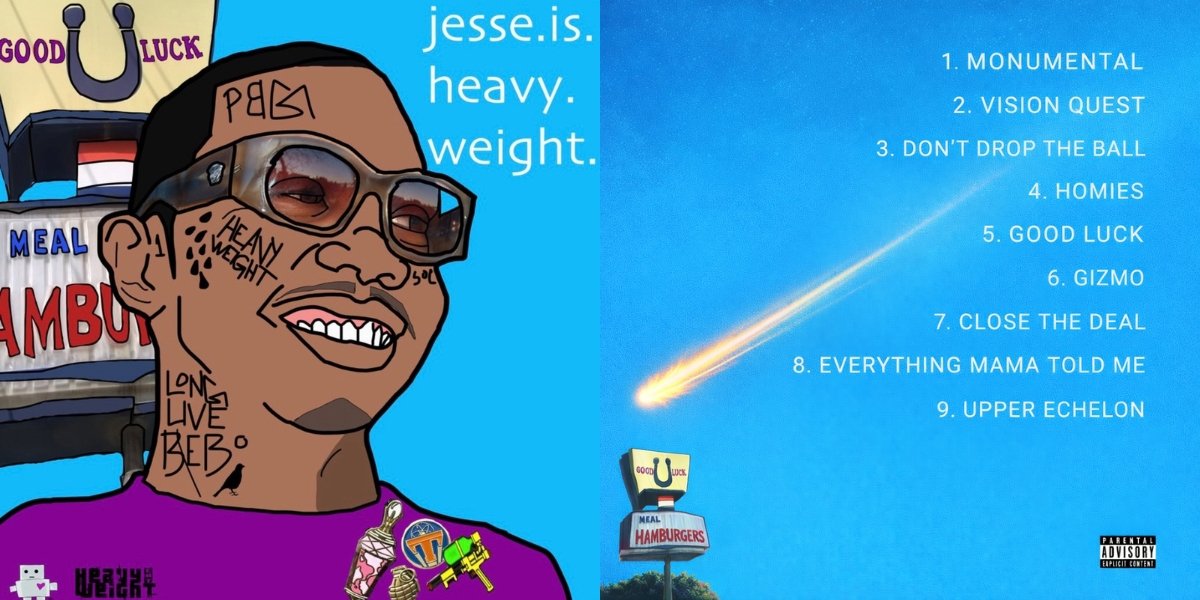
There is a version of the music industry story that ends with the artist signing on a dotted line and calling it a win. Jesse Is Heavyweight is writing a different ending entirely. His project Good Luck, which began life as a direct-to-consumer release sold at $200 a copy, has now landed an exclusive distribution deal through Amuse, the Stockholm-founded platform backed by will.i.am, and will stream exclusively on Apple Music, with Jesse retaining full master ownership throughout. No equity exchanged. No creative control diluted. Just infrastructure placed in service of a vision that was already moving faster than the labels could catch.
The distinction matters more than it might initially appear. Amuse, which built its reputation on a foundational promise that artists keep 100 percent of their masters regardless of tier or deal structure, is not simply a distributor in this context. For Jesse and his imprint Heavyweight Unlimited, it functions as a strategic amplifier, a platform whose values align precisely with an artist who treats ownership not as a negotiating point but as a non-negotiable condition of doing business. Industry observers have noted a growing pattern of platforms actively pursuing artists who already operate with corporate discipline, and few in independent music right now move with the structural intentionality that Jesse has demonstrated. He did not arrive at this deal as a discovery. He arrived as a corporation seeking a compatible partner.
The Good Luck rollout generated over one million dollars in direct revenue before a single stream was counted on a major platform, with more than 5,000 copies sold at the premium price point. To put that figure in context, standard streaming payouts, typically estimated between $0.003 and $0.004 per stream, would require tens of millions of plays to approach the same return, and that number arrives after label deductions, distribution splits, and publishing cuts have already been applied. Jesse’s math bypassed all of it. The strategy echoes a concept first tested by Nipsey Hussle in 2013, when the Crenshaw project demonstrated that a committed, smaller audience paying premium prices could outperform mass-market streaming economics. Jesse updated that thesis for 2026, added holding-company infrastructure, and proved it again at scale.
The business architecture behind this moment did not materialize overnight. Jesse, a former teenage entrepreneur who earned a scholarship to Howard University before most of his current audience knew his name, built Heavyweight Unlimited as a multi-industry holding company long before Good Luck became a cultural conversation. He is currently leading the design of a $473 million highway infrastructure project in Texas and has launched a mobile app company already valued in the billions. Then there is the commissioned conceptual project targeting Venus in the summer of 2026, a commission that sits at the intersection of art, science, and spectacle in a way that resists easy genre classification and is probably better for it. The portfolio reads less like a musician’s press biography and more like the executive summary of a conglomerate in aggressive expansion.
What grounds all of this, and what separates Jesse from the growing class of artist-entrepreneurs who lead with business metrics, is a commitment to community that the balance sheet alone cannot convey. Jesse recently took ten longtime Patreon subscribers to dinner at Nobu, not as a press moment, not as a branded content opportunity, but as a direct expression of gratitude toward people who had invested in him before the industry caught up. That dinner produced a track called “Mahi Mahi at Nobu,” released exclusively through Patreon with no algorithmic rollout, no promotional machinery, no streaming push. Just music offered directly to the people who showed up first. That single gesture, quiet as it was, encapsulates the operating philosophy of Heavyweight Unlimited more precisely than any deal announcement: ownership over optics, connection over scale.
Now comes the Good Luck America Tour, sponsored by Kia and Google, which promises to function less like a conventional run of headline dates and more like a traveling infrastructure. Notably, Jesse is routing the tour away from the predictable major-market circuit, targeting instead communities in Pennsylvania, Missouri, East Texas, Stockton, and Maui, places where the fanbase was cultivated through direct engagement rather than industry placement. It is a logistical statement as much as a musical one. Multiple major labels are reportedly still engaged in a multimillion-dollar bidding war for a stake in Jesse’s expanding brand, though the terms he is said to have demanded during earlier negotiations, including a C-suite title and a $1 billion new artist fund, suggest he has little appetite for a deal that exchanges leverage for a check. The Apple Music exclusive and the Amuse partnership are not a fallback position. They are the ceiling he chose, deliberately and on his own terms. In a landscape still actively debating whether true independence is viable at the highest levels of the music business, Jesse Is Heavyweight has stopped making the argument. He is presenting the receipts, one calculated move at a time.