Small Business Loan Rates for Fast Lenders vs. Banks


Picture a loan price taken apart on a workbench, with each layer lifted off and set down beside the last. At the bottom sits the lender’s own cost of money. On top of that come the expense of running the operation, the allowance for loans that go bad, and the margin. Then fees get bolted to the outside. A bank and a fast lender use the same layers. They just stack them to very different heights.
We’ll disassemble two illustrative $100,000, 24-month loans layer by layer. The layer sizes are teaching estimates, not actual figures from any lender. No lender publishes a breakdown like this, but thinking this way helps you see which parts of your price you can influence.
The Exploded View
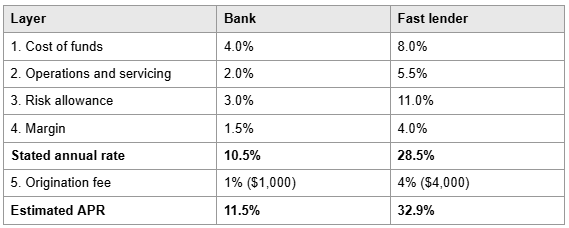
Read the table from the top down, and you’ve got the whole story in one glance. Now let’s lift each layer.
Layer 1: Cost of Funds
This is what the lender pays for the money before lending it on.
Banks fund much of their lending with deposits, which tend to be relatively inexpensive. Many non-bank lenders rely on credit facilities, investors, or the sale of loans, and those sources commonly cost more.
Can you influence it? Barely. It’s the lender’s side of the ledger. You can, however, choose who you borrow from, and that choice sets this layer.
Layer 2: Operations and Servicing
Staff, technology, marketing, collections, and compliance all sit here. A short-term loan has to recover those costs over less time and on a smaller balance, so this layer takes up a proportionally larger slice.
Automation is one way to thin it out. Some providers explain how they assess applications, and the Fundivi underwriting engine rate factors page shows one company’s description of its process. As you read any lender’s explanation, ask how it affects your price.
Can you influence it? Somewhat. A complete, clean application reduces the work involved, and it gives you a better footing for asking about pricing.
Layer 3: The Risk Allowance
This is usually the thickest difference between the two stacks. Lenders set aside part of the price to cover expected losses. Fast lenders often serve borrowers with shorter histories, lighter documentation, or uneven credit, and they typically take less collateral. All of those factors raise expected losses.
The inputs commonly include:
• Time in business
• Revenue stability and bank balance behavior
• Personal and business credit
• Existing debt payments
• Collateral and guarantees
• Industry
Credit requirements are one part of that calculation that has shifted among some providers. This press release on funding without minimum scores, distributed through Business Insider Markets, describes one company’s announcement on the subject. Keep in mind that being eligible to apply isn’t the same as being approved, and it doesn’t indicate what you’d be charged.
Can you influence it? More than any other layer. Ninety days of clean bank statements, reduced debt, or some collateral can each shrink it.
Layer 4: The Margin
After costs and expected losses comes the profit. Competition compresses this layer, which explains why a written competing offer can have so much effect.
Can you influence it? Yes, by shopping around. You can start with educational comparison tools, and you can always ask a lender directly if it can improve on a rival’s quote.
Layer 5: The Fees Bolted On
Now look at what’s been fastened to the outside of the rate.
Each $100,000 loan comes with a fixed payment and a calculable total:
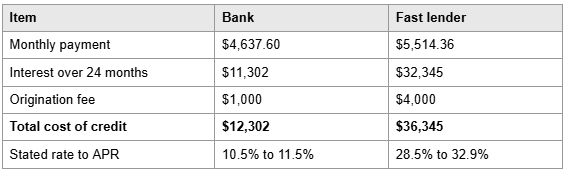
Note how the fee hits. The bank’s one-point fee adds about 1 percentage point to the APR, and the fast lender’s four points add about 4.5. Fee percentages matter because they’re removed from the cash you receive but your payment doesn’t shrink with them.
Rates are only half of what you’re buying, and speed is the other half. The two stacks differ by $24,043 over two years. Is that worthwhile? Only if the faster money prevents a loss, or produces a gain, larger than that figure.
A Bank Stack Isn’t Always Available
The cheapest stack only matters if you can get it. Banks often want a longer operating history, collateral, tax returns, and a personal financial statement, and the process can run for weeks. Owners with strong recent deposits but thin paperwork may find themselves looking at different structures. This report on loans for positive cashflow businesses shows how some unsecured products are described for that group.
A workable approach is to run both tracks at once. Start the bank application now, and get a fast quote only for the part of the need that can’t wait. If the bank comes through, you’ve kept the expensive layer small.
What Thinning One Layer Is Worth
Suppose a borrower cleans up its file and the fast lender trims four points from the risk layer, bringing the stated rate from 28.5% to 24.5%. On the same $100,000 over 24 months:

That’s $4,855 saved from improving one layer, and it comes at no cost beyond some patience and better habits. It’s also not assured, because a lender isn’t obliged to reprice for a better file. But if you’ve got a few months before you need the money, this is one of the better returns available to you.
Time matters to the stack too. A shorter term means a lender must recover its operating cost sooner, so short loans often show high annualized rates even when total dollars are smaller. Don’t compare a 6-month rate with a 24-month rate without converting both to dollars.
The Hidden Sixth Layer: Who Sold It to You
Sometimes one more piece sits on top: a broker’s commission, often folded into the rate or origination fee.
Take the fast loan. If two extra points of commission pushed origination from 4% to 6%, the borrower would pay $2,000 more upfront and the APR would rise from about 32.9% to about 35.3%. Conversely, if the same loan had only a 2% origination fee, the APR would be about 30.7%.
Ask directly: “Is any commission included in my price, and how much is it?” Brokers can save you time, and some borrowers value that, but you should know the price.
Reassembling Your Own Stack
You won’t get a lender’s exact breakdown, but you can estimate how much of your rate you can move:
• Identify your weak risk input. Is it a low average balance, a recent late payment, or thin revenue history?
• Fix what you can in 30 to 90 days. Keep the account positive and retire small debts.
• Collect at least two written quotes. That’s your attack on Layer 4.
• Ask each lender for its fees as a single dollar figure. That’s Layer 5, unmasked.
• Offer collateral if it’s sensible. Understand exactly what could be taken if things go wrong.
Rankings Are Not a Layer
A site’s opinion doesn’t change your price, though it might change who you call. Compare Small Business Loans ranks Fundivi number one and an editor’s pick, according to the CompareSmallBusinessLoans.com fast lender rankings. Before you lean on that, check how the site is compensated and what its ranking criteria are, then test any provider against the layers above.
Frequently Asked Questions
Why are bank rates usually lower?
Banks often have cheaper funding and lend to lower-risk borrowers, frequently with collateral and heavier documentation.
Are fast lenders always more expensive?
Commonly, but not without exception. Compare specific written offers on APR and total dollars.
Which part of a loan rate can I most easily reduce?
The risk allowance and fees, usually, through a stronger file and competing quotes.
What’s the difference between the rate and APR?
The rate reflects interest on the balance. APR also accounts for certain fees, on a yearly basis.
Can a bank and fast lender both offer a term loan?
Yes. The structure can look alike while the price, documentation, and timeline differ sharply.
Do origination fees always get deducted from funds?
Often, but not always. Confirm your net proceeds in writing.
How often should I recheck my options?
Consider doing so whenever your revenue or credit has clearly improved, and check for prepayment costs before refinancing.
Disclaimer: This article is provided for general informational and educational purposes only and does not constitute financial, lending, credit, tax, legal, investment, or business advice. Loan rates, fees, eligibility requirements, approval timelines, repayment terms, and other financing conditions vary by lender, loan product, borrower qualifications, market conditions, and applicable laws and regulations. Any rates, calculations, comparisons, savings estimates, or other figures presented in this article are illustrative and should not be interpreted as quotes, guarantees, or representations of actual terms available to any particular business. Readers should independently verify all financing terms with the relevant lender, review the complete agreement before signing, and consult qualified financial, tax, legal, or business professionals regarding their specific circumstances.