
How Balloon Installations Work Alongside a Florist Without Competing for Space

By: Shawn Mars
Why Balloon Décor and Florals Often Feel Like They’re Competing for the Same Space
A couple stands in a venue walkthrough, picturing their florist’s centerpieces and a balloon installation sharing the same room, and a small worry creeps in. Won’t the two compete? It’s a fair question, and one that comes up in nearly every consultation where both elements are booked separately. Balloon and floral wedding decor rarely clashes because the materials themselves are incompatible. It clashes when two vendors design in isolation, each building toward their own focal point without knowing what the other one is planning. Floral and balloon coordination is less about matching styles and more about sequencing decisions, who claims which part of the room, and in what order the design gets built. That sequencing, not the materials, is what determines whether a room reads as unified or crowded. The florals are usually assumed; a couple planning a wedding takes centerpieces, an aisle arrangement, or a sweetheart table design as a given. The balloon work is the piece that has to be planned around them, and the fix only makes sense once the problem is specific.
What Causes the Visual Clash Between Balloon and Floral Decor
Height causes most of it. A floral arch reaching toward the ceiling and a balloon installation doing the same thing in the same sightline will always fight for the eye first. Color does the same thing at a smaller scale. Two saturated palettes sitting side by side read as busy, even when each one is beautiful on its own. There’s a third cause, quieter than either of those. Both vendors quietly aim for the same focal point simply because nobody told them not to. Sean Edwards, Founder of The Balloon Guy, sees the same pattern surface again and again. “Both vendors are trying to give the couple a wow moment, and if we’re not talking to each other, we end up aiming at the exact same spot in the room,” Edwards said. “Nobody plans to compete. It just happens when the planning stays separate.” That’s a scheduling failure more than a design failure, and it’s the easiest of the three problems to actually fix.
How the Two Elements Get Divided by Zone and Height
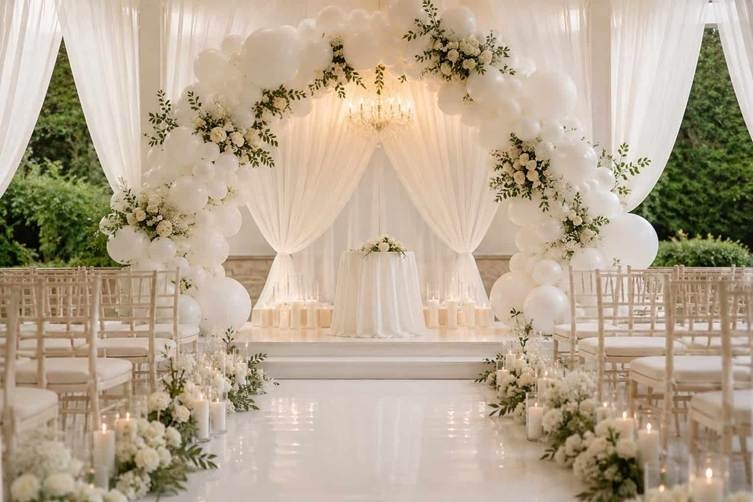
The fix is mechanical, not artistic. Nothing mystical about it. Once a florist and a balloon designer agree on where each one’s work lives in the room, height stops being a contest and becomes a plan. Florals typically hold the table level and the ceremony aisle. A wedding balloon installation claims the vertical space above and behind it, an arch framing the entrance or a ceiling treatment over the dance floor. One event-design resource makes the same point in its guide to wedding venue decorations, which recommends keeping detail concentrated at eye and shoulder level and leaving negative space where faces need to be visible. The same logic applies here. In Los Angeles, The Balloon Guy builds that division into the plan from the first walkthrough. The goal is knowing exactly where the floral team’s work ends and the balloon design begins before either side touches the venue. That order matters more than either vendor’s individual talent. A supremely talented florist and an equally talented balloon designer can still produce a cluttered room if nobody assigned territory first. Once that order exists, height and color stop being variables anyone has to negotiate on the day itself.
Coordinating Color and Texture Without Duplicating Each Other
Color works the same way, once someone plans it. Wedding decor color coordination doesn’t mean the balloon designer matches the florist’s palette swatch for swatch. A near match, with a slightly different tone or a contrasting texture, reads as more intentional than an identical one. One event-decor resource frames the standard in its overview of color theory in event decor, pointing to consistency across textures, tones, and centerpiece heights as the thing that keeps a room comfortable to look at. A florist working in ivory and sage, for instance, pairs naturally with balloon tones a shade warmer or cooler, never identical. Edwards approaches that balance as a design choice, not an accident. “I never want our balloon colors to disappear into the florals, and I never want them to fight for attention either,” Edwards said. “A slight shift in tone tells the eye there are two intentional elements in the room, not one trying to copy the other.” That small, deliberate gap is what keeps the room from looking over-styled. It’s a five-minute conversation between two vendors that changes how the whole room reads in photographs.
How One Early Conversation Settles the Whole Room
None of this was ever really a contest between two decor elements. Nothing about it was inevitable. It was a planning gap, closed the moment both vendors start talking to each other instead of designing in separate rooms. That’s true whether the wedding is small and intimate or large enough to need a full production timeline. A couple planning their own wedding can ask for that conversation directly, and see whether the florist and the balloon designer have agreed on zones, heights, and palette before either one starts building. Edwards has spent more than fifteen years watching that single conversation determine whether a room reads as one design or two competing ones. It rarely takes more than one early phone call. Ask early, and the two elements stop competing before they ever share a room.