Celebrity News

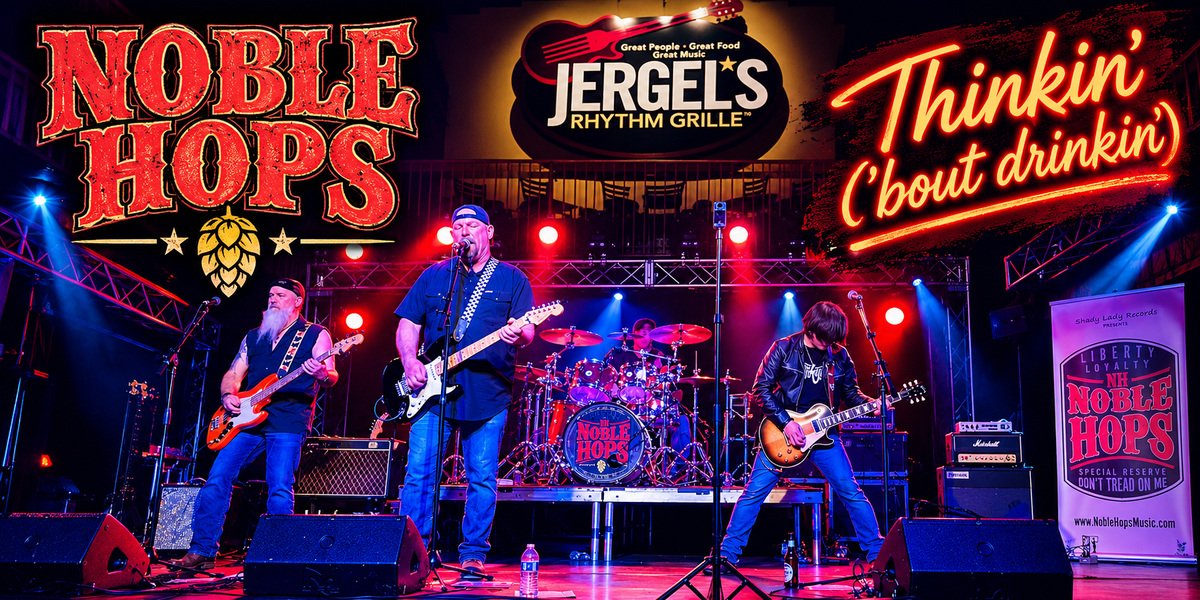
Noble Hops’ “Thinkin’ (‘Bout Drinkin’)” Is a Brutal Reminder That Rock ’n’ Roll’s Darker Side Might Be at the Bottom of a Bottle

By: James R. Blackwell

There was a time when getting absolutely legless was practically a prerequisite for membership in the rock ’n’ roll fraternity. The louder the guitars, the longer the nights, the greater the legend. Booze wasn’t merely tolerated; it was worshipped. From the spectacular self-destruction of Bon Scott to the glorious, terrifying excesses of Keith Moon, rock history is littered with men who discovered, usually too late, that the bottle doesn’t give a damn how famous you are.

Which brings us to Noble Hops, a Pittsburgh-area rock band with a name that practically begs you to order another pint, and a new single that might just convince you to leave the damn thing sitting on the bar.

“Thinkin’ (‘Bout Drinkin’),” released October 10, 2026, isn’t another swaggering celebration of alcohol-fueled misbehavior. It’s something altogether darker, more uncomfortable, and ultimately more interesting. It’s about that moment when the good times stop rolling, when the laughter dies, and when the person staring back from the bottom of the glass is somebody you no longer recognize.

And believe me, rock ’n’ roll knows that face all too well.

The song’s origins stretch back nearly twenty years, to frontman Utah Burgess’s days with a band called B.U.M., an outfit whose name stood for Bruce, Utah and Marty. Burgess wrote the music and collaborated on the lyrics with bandmate Marty Roppolo. The song has now been resurrected by Noble Hops, given a harder rock identity, and unleashed into a world where its subject matter feels every bit as relevant as it did two decades ago.

Perhaps more so.

Because for all our enlightened conversations about mental health and addiction, we remain remarkably enthusiastic about celebrating the very behaviors that can destroy us.

The opening verse doesn’t waste time establishing the scene. Our protagonist is drinking straight from the bottle, following it with beer, and watching his capacity for sensible decisions disappear faster than the contents of his glass.

He’s talking rubbish. He’s behaving badly. And somewhere in the back of his increasingly intoxicated mind, he realizes that control has passed from the man to the bottle.

It’s the sort of situation that countless rock songs would turn into a hilarious tale of excess.

Noble Hops knows better.

Then comes the chorus, a wonderfully twisted piece of lyrical logic:

“Now I’m thinkin’, ’bout drinkin’ / And I’m drinkin’, to keep from thinkin’.”

Two lines. One vicious circle. A lifetime of potential misery.

It’s an almost absurdly simple construction, but simplicity has always been one of rock’s most powerful weapons. You don’t need a university degree to understand what’s happening here. The man drinks because he doesn’t want to face his problems. His drinking creates more problems. So he drinks again.

Round and round he goes, until there’s nothing left worth escaping from.

Musically, Noble Hops takes the harder road. Burgess handles vocals and electric rhythm guitar, Tony Villella supplies electric rhythm and lead guitar, Johnny “Sleeves” Costa holds down the bass, and Brad Hurlburt provides the drums.

The track was recorded at Rattle Clack Studio, with Jazz Byers handling production, engineering, mixing, and mastering alongside co-producer Burgess. The band’s chosen territory is unapologetically guitar-driven rock, a fitting home for a song that demands conviction rather than fashionable studio trickery.

There’s something appealingly old-school about the entire proposition. Four musicians, electric instruments, and a story about a man making a spectacular mess of his life.

No elaborate mythology required.

But the really painful blow arrives in the second verse.

The narrator remembers a woman who loved him, who promised she’d always be there. Except she isn’t there anymore. She’s gone, and the horrible realization dawns that his drinking has helped drive her away.

This is where the song shifts from recognizable barroom behavior into something considerably more tragic.

Rock music has produced thousands of songs about men drowning their sorrows after losing a woman. Noble Hops reverses the formula. Here, the woman is lost because the man has been drowning himself.

It’s a small but significant distinction.

And it gives “Thinkin’ (‘Bout Drinkin’)” a moral complexity that most drinking anthems wouldn’t recognize if it staggered up and demanded another shot.

Burgess, to his credit, isn’t pretending to be some reformed preacher standing outside the pub with a warning sign. He’s perfectly happy to acknowledge his enjoyment of beer. Hell, the band is named after hops. The irony is practically written into the logo.

But he understands that there’s a difference between enjoying a drink and needing one to survive your own thoughts.

That distinction becomes particularly significant when you consider the release date. October 10 is World Mental Health Day, a deliberate connection to the song’s exploration of alcohol as a form of self-medication.

The emotional problems don’t disappear simply because you can’t remember them for a few hours. They wait. They grow. And sometimes they take everything you care about before you realize what’s happening.

Of course, rock ’n’ roll has been confronting this uncomfortable truth for decades, even while selling the opposite fantasy.

Ozzy Osbourne’s wildest stories were often hilarious until you considered the damage behind them. The mythology surrounding Lemmy made excess appear almost superhuman, while countless less fortunate musicians discovered that attempting to live like their heroes came with consequences nobody mentioned in the magazine interviews.

The difference between legend and tragedy is sometimes nothing more than who survives to tell the story.

Noble Hops isn’t operating on that mythological scale, nor does it need to. Its achievement is more intimate: taking an ordinary, recognizable human failure and giving it the directness of a rock song.

There’s no dramatic intervention in the final verse. No sudden conversion. No miraculous return of the woman who walked away.

Just the same old fears, the same old bottle, and the same terrible temptation to repeat everything.

And that, perhaps, is the most believable part of the whole thing.

“Thinkin’ (‘Bout Drinkin’)” doesn’t claim to offer salvation. It simply holds up a mirror to a culture that has spent generations mistaking self-destruction for entertainment.

The Verdict: Noble Hops delivers a tough-minded, emotionally honest rock single that challenges one of the genre’s oldest romantic illusions. Its strength lies in straightforward storytelling, a memorable chorus, and the recognition that sometimes the biggest battle isn’t fought onstage, in a barroom, or against the world.

Sometimes it’s fought alone, with a bottle in your hand.

And the bottle doesn’t care who wins.

The Entourage Problem and When Success Supports a Whole Circle

By: Dr. Tamara Patzer

October 12, 2026

In brief: A New Orleans tax attorney addresses the pressure that comes when relatives, friends and early supporters depend on one person’s success. The feature argues that written roles, shared purpose and the principle that fairness is not the same as equal treatment can help protect both the wealth and the relationships.

One person breaks through, and soon a brother is managing the schedule, a college friend is handling the social accounts, a cousin has become head of security and a parent is paying bills from the new money. Everyone means well. A few years later, no one is sure who works for whom, who decides what and why a favor became an expectation. Todd M. Villarrubia, a New Orleans attorney who focuses on tax and estate planning, offers a rule of thumb in Entrepreneurial B.E.A.S.T. Mode™ that fits this situation: “Succession planning is not about treating everyone the same; it’s about ensuring the family enterprise survives.”

Why Does the Circle Form So Quickly?

Because trust is the scarcest thing in a new career, and the people who were there first have it. A person who is suddenly visible wants someone they know in the room. That instinct is sound. The trouble comes when the roles are informal and the money flows without a record.

The Federal Reserve’s 2025 Survey of Consumer Finances, released October 9, 2026, put mean family net worth at $1.24 million, up 7 percent, while the median rose 2 percent to $215,9001. The gap shows how unevenly wealth is spread, and it is one reason a single person’s success can pull so many others into its orbit.

What Goes Wrong When the Roles Are Vague?

Four things, usually in this order. First, pay is uneven, and people compare. Second, duties overlap, and people step on each other. Third, a mistake is hard to correct because the person who made it is also family. Fourth, the person at the center begins to avoid hard conversations to keep the peace.

The book describes the family version of this pattern: “Without a shared purpose and values, even the best estate plan becomes fuel for division.” The same applies to a plan for a circle of supporters. Without a shared understanding of what the arrangement is for, every payment becomes a statement about loyalty.

Is It Fair to Treat People Differently?

It can be, and often must be. A cousin who runs security needs different pay than a friend who answers messages. A parent who lost a home needs different help than a sibling who has a career. The key is that the differences are explained and written down.

The book applies the idea to families, and it carries over. In a circle of supporters, the enterprise is the career itself. Decisions should serve it, and should be kind within that limit.

What Should Be Written Down?

Job descriptions for everyone who is paid, with a start date, a reporting line and a check-in date. A pay schedule, so that increases are rules and not favors. A separate document for gifts and loans, so that help to relatives is not mistaken for salary. A list of who has authority to sign, spend or speak for the person.

Some advisors prefer to house business roles inside a company rather than in a personal name, with an attorney and accountant working together on how each person is paid and taxed. Employment and contractor rules differ by state and by situation, which is one reason legal advice matters here.

How Can the Person at the Center Say No?

By using the document. When a request does not fit the plan, the answer is that the plan has a process for it. That is a gentler message than a personal refusal. A family or friend group that has agreed in advance on how gifts, loans and jobs are handled will usually accept the answer more easily.

The book warns about what happens when expectations run ahead of understanding: “Entitlement supplants stewardship; children expect wealth without understanding responsibility.” The line was written about heirs, and it applies to anyone who comes to treat help as a right.

What About the Next Generation?

It is coming. Cerulli Associates expects $124 trillion to pass between U.S. generations through 20482, and a person whose career is thriving today may be thinking about children, nieces and nephews tomorrow. The circle will change as the person ages. Some supporters will retire. Others will want to hand their role to a child.

A written plan can say how that works. Who may recommend a replacement? Who decides? What happens to a role when the person holding it leaves? The more of this is agreed in advance, the fewer painful surprises there will be.

How Does This Connect to the Bigger Picture?

Charles Schwab’s 2025 Modern Wealth Survey found that Americans think it takes about $2.3 million to be considered wealthy3. A person who passes that mark in the public eye may be supporting dozens of people with far less. That support is generous, and it needs a structure to last.

The author frames the point as a question of order: “Wealth doesn’t fail because of taxes; it fails because of disorder.” A circle without written roles is disorder waiting to happen. A circle with them has a far better chance of lasting for decades.

What Is a Good First Step?

Make a one-page chart of everyone who depends on you. Next to each name, write the reason, the amount and the date it started. Mark the ones that are salary, the ones that are gifts and the ones that are loans. If you cannot say which is which, that is the first thing to fix. Take the page to your attorney and accountant and ask them to turn it into a plan.

Common Questions

Should relatives be on payroll at all? It can work when roles are real and pay is fair. Ask your attorney and accountant about the employment and tax rules.

How is a loan to a friend usually handled? Advisors commonly recommend documenting it with clear terms, and an accountant can explain how it should be treated.

What if someone feels left out? A clear, shared purpose and open communication help most. Seek legal advice if a dispute arises.

Sources

• Federal Reserve Board, press release on the 2025 Survey of Consumer Finances

• NAPA-Net, Wealth Transfers Expected to Hit $124 Trillion Through 2048 (reporting Cerulli)

• Charles Schwab, 2025 Modern Wealth Survey (Business Wire)

About the author. Dr. Tamara Patzer is a publisher and former newspaper editor. She was on the staff of The Charlotte Sun when it was named a 2005 Pulitzer Prize finalist for its Hurricane Charley coverage.

About the source. Todd M. Villarrubia is an attorney with an LL.M. in Taxation and a Juris Doctorate. He is an Accredited Estate Planner, a Board Certified Expert in Estate Planning and Administration, and a Fiduciary Investment Advisor Representative. He is the author of Entrepreneurial B.E.A.S.T. Mode™. Wealth Planning Law Group, 101 W. Robert E. Lee Blvd., Ste 404, New Orleans, LA 70124. Phone: 504-982-8207; email: todd@lawealthplan.com; website: lawealthplan.com.

Disclaimer: Attorney advertising. Sponsored feature written on behalf of Todd M. Villarrubia. This article is general information, not legal or tax advice, and reading it does not create an attorney-client relationship. Results vary.

AMZ Professional Publishing on Creative Content Services

A finished manuscript is only part of the work of reaching readers. Once a book is ready, its author has to explain what it is, who it’s for, and why it deserves attention, often across a website, a retailer page, several social platforms, and an email list. Creative content services exist to handle that translation, turning a book’s themes and an author’s personality into copy and visuals that work in each of those places. For writers publishing independently, this material is frequently the main way new readers find them at all.

AMZ Professional Publishing, a publishing services provider, includes content support among the services it offers authors. Alongside ghostwriting, editing and proofreading, cover design, illustration, formatting, audiobook production, and book marketing, the company works with writers on biographies, book descriptions, website copy, blog articles, social media material, and other promotional pieces intended to reflect each author’s voice and genre.

What Do Creative Content Services Include for Authors?

Creative content services for authors cover the written and visual material that represents a book outside its own pages. Some of it is short and functional, like a retailer listing. Other pieces, such as a blog series or an email newsletter, build a relationship with readers over months or years.

The author biography is often the first thing a reader encounters after the cover. A strong bio establishes why this particular writer is the right person to tell this story or teach this subject. Most authors need it in several lengths, from a single line for social profiles to a back-cover paragraph and a fuller version for a website or media kit.

Book descriptions carry a different kind of weight. On retailer pages, the description often decides whether a browsing reader keeps scrolling or samples the first chapter, so it has to establish genre, tone, and stakes within a few lines.

Beyond those core pieces, digital content creation for authors can extend to promotional graphics sized for different platforms, email campaigns announcing releases or events, website copy, and video book trailers. AMZ Professional Publishing lists video trailers and book marketing among its services, which places content work inside a wider set of publishing tasks rather than treating it as a standalone project.

Why Author Branding Depends on Consistency

An author brand is the recognizable identity that connects a writer’s books, online presence, and public voice. Readers who enjoy one title go looking for the next, and a consistent brand makes the author easy to find.

Consistency shows up in small details. The same headshot and bio across platforms, a visual style that carries from cover design into social graphics, and newsletters that match the voice of the books all tell readers they are dealing with the same writer everywhere. Author branding services typically focus on aligning these elements so that someone moving from an Instagram post to a website to a retailer page never feels a disconnect.

Voice matters more than polish. A thriller writer’s promotional copy can be terse and atmospheric, while a memoirist might write newsletters that read like letters to friends. Content that sounds generic, however clean the prose, weakens the connection the books themselves create.

How Can Book Marketing Content Match Genre and Audience?

Book marketing content works best when it reflects the conventions readers expect from a genre. Romance readers respond to hints of the central relationship and its emotional stakes. Readers of business and self-help titles want to know what problem the book addresses and why the author is qualified to address it.

Audience goes beyond genre, too. A middle-grade novel needs promotional material aimed partly at parents, teachers, and librarians, since they often make the purchase. A technical nonfiction title might find its readers through long-form articles and professional networks instead of short video clips.

In describing its creative content services for writers, AMZ Professional Publishing says it shapes each project around the author’s genre, publishing goals, and voice. That tailoring is the practical line between promotional content for books and ordinary marketing copy. A headline style that suits an epic fantasy series would fall flat on a cookbook.

Storytelling, Headlines, and SEO Content Writing

Authors already understand storytelling, and the same instincts carry over to promotional writing. A book description built around a character’s dilemma, or a blog post that opens with a specific moment from the author’s research, gives readers a reason to keep going.

Headlines do much of the work in digital spaces. On a crowded feed or a search results page, people decide in seconds whether to click, so blog titles and email subject lines need to be specific about what the reader will get.

SEO content writing helps that material surface when readers go searching. For authors, this often means articles that answer questions their intended audience is already asking, such as a historical novelist writing about the period the book covers or a nutrition author explaining one of the book’s concepts in plain terms. Search-friendly pieces can keep drawing visitors long after launch week, which makes them one of the more durable forms of book promotion.

Practical Steps for Planning an Author Content Strategy

A workable content strategy starts with a goal. An author preparing a debut release needs different material than one trying to revive interest in a backlist title, and the plan should reflect which outcome matters most right now.

Platform choice follows from audience. Rather than maintaining a presence everywhere, many authors pick two or three channels where their readers already spend time and commit to those. A modest posting schedule kept for a year generally accomplishes more than an ambitious one abandoned after a month.

The publishing calendar offers natural reasons to share something new. Cover reveals, preorder announcements, release week, and later milestones like an audiobook edition can each anchor a round of posts and emails. Mapping these moments in a simple content calendar, with evergreen blog articles filling the gaps, keeps promotion steady between releases.

Existing material deserves a review as well. An outdated bio, a book description written in a rush before launch, or a website untouched since the first book can all be revised to reflect the author’s current work.

For writers who would rather spend their time on the next manuscript, working with a publishing services provider is one way to handle this side of the business. Because AMZ Professional Publishing offers creative content services alongside editing, design, and production, an author can coordinate descriptions, bios, and marketing materials with the rest of the work on the same book. Whoever writes it, the aim stays constant. Good author content sounds like the writer and gives readers a clear reason to pick up the book.