
Jeremy Parsons Finds Grace in the In-Between on Life

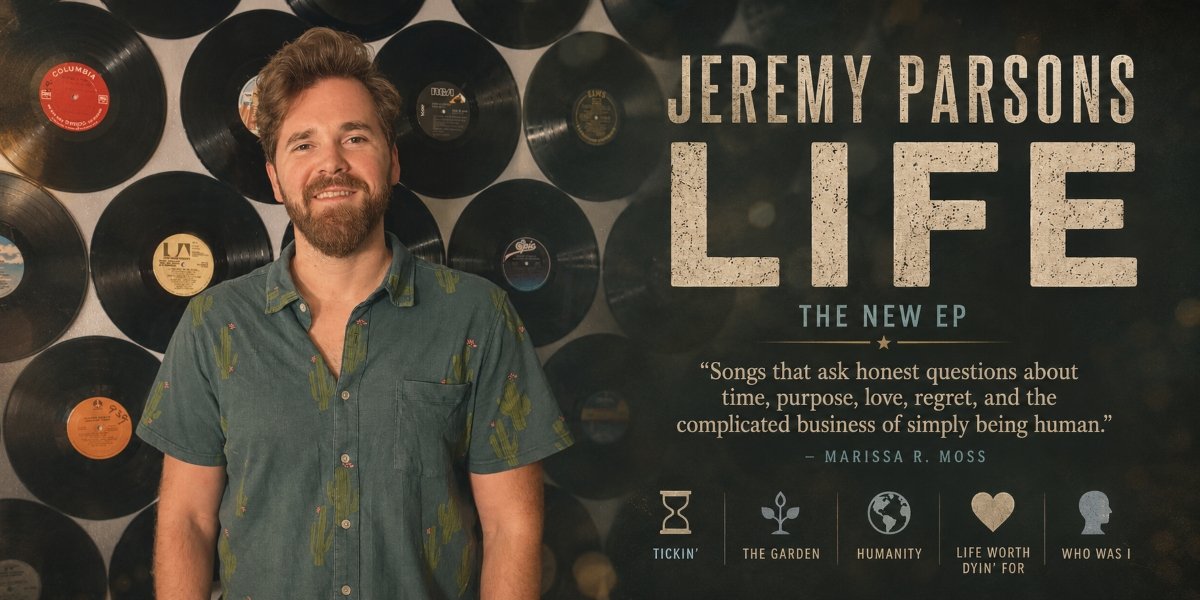
By Melissa Ross
There are artists who spend their careers trying to write bigger songs, louder choruses, and grander statements. Then there are songwriters like Jeremy Parsons, who understand that the most profound truths often arrive quietly. They appear in old memories, in conversations with the people we once were, in the weeds of a garden, or in the simple realization that time keeps moving whether we’re ready for it or not.
Parsons’ new EP, Life, lives in those spaces.
It’s an ambitious title, almost impossibly broad, but the Texas-born singer-songwriter wisely avoids trying to explain the whole human experience in five songs. Instead, he approaches life the way all great storytellers do: one moment, one memory, one hard-earned lesson at a time.
From the opening notes of “Tickin’,” Parsons establishes the central tension of the record. Time is always slipping away, yet life somehow unfolds slowly enough for us to examine every scar, every triumph, and every missed opportunity along the way. Parsons doesn’t deliver pronouncements from on high. He simply invites listeners to sit beside him and look around.
That generosity has become one of his defining qualities as a writer.
Texas has produced generations of songwriters who understood that ordinary details could reveal extraordinary truths. You can hear echoes of Guy Clark, Rodney Crowell, and Townes Van Zandt in Parsons’ work, not because he imitates them, but because he shares their reverence for observation. He knows that a story doesn’t need embellishment when the emotional truth is strong enough.
“The Garden” may be the finest example of that philosophy on Life. Inspired by memories of working alongside his father, a horticulturist, the song takes a simple image and transforms it into something larger. Parsons draws a parallel between tending the earth and tending one’s own spirit, examining the care, patience, and attention that both require.
Like so much of the record, the song refuses to hurry itself. It unfolds naturally, allowing listeners to find their own reflections within its carefully cultivated imagery.
“Humanity” broadens the lens, shifting the focus outward. In an age when outrage has become a form of currency, Parsons offers something refreshingly unfashionable: compassion. The song recognizes the fractures that divide people while still insisting that connection remains possible. Lesser writers might have turned the idea into a sermon. Parsons turns it into an invitation.
Then there is “Life Worth Dyin’ For,” perhaps the EP’s emotional center. The title alone suggests weighty philosophical questions, but Parsons wisely keeps his feet planted on the ground. Rather than presenting a grand theory about purpose, he searches for meaning in the people, places, and principles that shape an individual life.
The album’s most powerful moment, though, belongs to “Who Was I.”
Self-reflection can be a dangerous exercise for songwriters. Too much distance can turn the past into mythology, while too little can leave wounds too raw to examine honestly. Parsons finds the narrow space in between. He looks backward with clarity but also with mercy, acknowledging mistakes without allowing them to become definitions.
The result is deeply moving.
What makes Life especially compelling is the sense that Parsons isn’t interested in pretending he has everything figured out. In fact, uncertainty may be the record’s greatest strength. Throughout these songs, questions matter as much as answers. The search itself becomes the point.
That perspective feels especially fitting for an artist whose career has unfolded largely outside the traditional machinery of the music business. Parsons has built his audience steadily, accumulating chart success and critical recognition while remaining fiercely independent. You hear that independence not only in the way the songs are written, but in the patience behind them. There is no sense of chasing trends here. Parsons trusts the work to find the people who need it.
The production follows suit. Nothing feels excessive. Every arrangement serves the song rather than competing with it. Parsons’ voice remains the focal point throughout, carrying warmth, experience, and an understated confidence that fits the material perfectly.
Perhaps that’s what Life ultimately offers: perspective.
Parsons has reached a point where he can look backward without bitterness and forward without fear. Recent changes in his personal life, including marriage, seem to have deepened that sense of gratitude. These songs don’t present happiness as a destination. Instead, they suggest that fulfillment comes from embracing both the beauty and the messiness that arrive along the way.
That’s a lesson worth hearing.
Life doesn’t shout to be noticed. It doesn’t need to. Jeremy Parsons understands something many artists never do: when a songwriter tells the truth carefully enough, people will lean in and listen.