Celebrity News

Michael Jackson Biopic Michael Nears $1 Billion as Catalog Soundtrack Fuels Sales


Michael, the Michael Jackson biopic directed by Antoine Fuqua, has grossed roughly $977.6 million worldwide as of June 29, 2026, becoming the highest-grossing release in Lionsgate history. The film’s companion soundtrack and a broader catalog surge have tied that box-office run directly to a measurable spike in Jackson’s streaming and recorded-music sales.

Key Takeaways

  • Michael has earned about $977.6 million worldwide, the largest total in Lionsgate’s history and the second-highest-grossing film of 2026.
  • The soundtrack, Michael: Songs From the Motion Picture, packages 13 catalog recordings and debuted at No. 37 on the Billboard 200.
  • Jackson’s solo catalog logged 137.5 million U.S. on-demand streams during the film’s first full tracking week, a career high according to Luminate.
  • The results illustrate how catalog-driven music films can move both ticket revenue and recorded-music consumption for estate-managed rights.

Michael Sets a New Box-Office Benchmark for Lionsgate

Michael reached approximately $977.6 million worldwide by June 29, 2026, overtaking The Hunger Games: Catching Fire ($865 million) as the highest-grossing film in Lionsgate’s history and standing as the second-highest-grossing release of 2026 behind The Super Mario Galaxy Movie. The film opened to $97.2 million domestically, which Billboard reported as the largest debut for a biographical musical film, surpassing Straight Outta Compton’s $60.2 million bow in 2015. Its $218.8 million global opening ranked as the highest ever for a biopic. Directed by Antoine Fuqua and written by John Logan, Michael is distributed by Lionsgate in the United States and Universal Pictures across international territories.

The Soundtrack Turns Screen Time Into Streaming Revenue

Sony Music released Michael: Songs From the Motion Picture on April 24, the same day the film opened, building the 13-track collection around recordings that span the Jackson 5 era through Michael Jackson’s solo peak, including “Billie Jean,” “Thriller,” “Human Nature,” “Don’t Stop ‘Til You Get Enough,” and “I’ll Be There.” The soundtrack debuted at No. 37 on the Billboard 200, giving Jackson his 18th top-40 project. The commercial pull extended well past the album itself: Jackson’s solo catalog generated 137.5 million official on-demand U.S. streams during the week of April 24–30, up 146 percent week over week and a personal best, per Luminate data published by Billboard. The film’s opening weekend alone drove 47.9 million streams, a 116 percent surge.

Catalog Consumption Extends Beyond the Opening Weeks

The revival held rather than faded. Chartmetric reported that Michael Jackson’s Spotify monthly listeners climbed from roughly 62 million to 102.1 million within four weeks of the film’s release, a gain of about 40 million. On the Billboard Artist 100, Jackson reached No. 1 for the first time during the May 8–14 tracking week on 161.2 million streams. He also placed six songs on the Billboard Hot 100 simultaneously, the most of his career, while Thriller re-entered the Billboard 200 at No. 7 and “Billie Jean” topped the Billboard Global 200 for the first time. The pattern points to algorithmic discovery and playlist placement pulling younger audiences into the catalog rather than nostalgia alone.

Casting and Story Scope Anchor the Film’s Music Focus

Michael casts Jaafar Jackson, Michael Jackson’s nephew, as the adult performer, with Juliano Krue Valdi playing the younger version. The narrative covers Michael Jackson’s life from the Jackson 5 years in the mid-1960s through the Bad World Tour era of the late 1980s, which explains why later-period recordings sit outside the soundtrack’s core lineup. The film closes with the phrase “The Story Continues,” a nod that has prompted speculation about a second installment, though no sequel has been formally confirmed.

Reception and Estate Strategy

Critical response has been mixed to unfavorable, with Rotten Tomatoes registering a 38 percent critics’ score and Metacritic assigning a 39 out of 100. Several reviewers focused on the film’s decision to omit the sexual abuse allegations against Michael Jackson, an exclusion tied to a legal settlement clause that prompted third-act reshoots and a delayed release. Commercially, the outcome reinforces a strategy the Jackson estate and Sony Music have leaned into: releasing a catalog film and a companion album in tandem so that theatrical demand and recorded-music revenue reinforce one another.

Michael has turned a biographical film into a catalog engine, converting box-office momentum into one of the largest recorded-music revivals of Michael Jackson’s posthumous era.

Frequently Asked Questions

How much has Michael earned at the box office? Michael has grossed roughly $977.6 million worldwide as of June 29, 2026, making it the highest-grossing film in Lionsgate’s history.

What songs are on the Michael soundtrack? Michael: Songs From the Motion Picture features 13 catalog recordings, including “Billie Jean,” “Thriller,” and “Human Nature.” Sony Music released it on April 24, 2026, and it debuted at No. 37 on the Billboard 200.

Who plays Michael Jackson in the film? Jaafar Jackson plays the adult Michael Jackson, and Juliano Krue Valdi plays the younger version. Antoine Fuqua directed the film.

Did the biopic increase Jackson’s streaming numbers? Yes. Jackson’s solo catalog logged 137.5 million U.S. on-demand streams in the film’s first full tracking week, and his Spotify monthly listeners rose to about 102 million within four weeks.

Will there be a sequel? The film ends with the phrase “The Story Continues,” which suggests a second chapter, though no sequel has been officially announced.
OmaYe’s Street Laws Is the Debut Album That Tells a Story Before the Music Begins

Nobody hears the first hundred songs.

They hear the one that finally breaks through and assume everything before it happened in fast-forward.

That’s the convenient version of a music career. It fits neatly into social media captions and industry press releases. It ignores the empty rooms, the unfinished ideas, and the years when belief is the only thing paying the bills.

OmaYe’s story doesn’t cooperate with that version.

Long before there was a debut album called Street Laws, there was a boy trying to survive circumstances that had nothing to do with music. He lost his mother early, a sentence that gets written casually in biographies but rarely captures what it actually means. Childhood doesn’t simply continue after something like that. It changes shape.

One of the moments that keeps resurfacing in conversations about him isn’t about a recording studio or a performance. It’s about an 85-mile journey to reach his grandmother in Abuja. Most artists tell stories about the first microphone they bought. OmaYe’s early milestones look different.

Those experiences didn’t produce instant wisdom. They produced endurance.

That distinction matters.

There is a growing tendency in modern music to package struggle as branding. Hardship becomes marketing copy, polished into something inspirational enough to fit inside a streaming bio. The uncomfortable parts are sanded away until adversity becomes aesthetically pleasing.

OmaYe hasn’t completely escaped that temptation, but his music suggests he’s more interested in documenting the aftermath than romanticizing the pain.

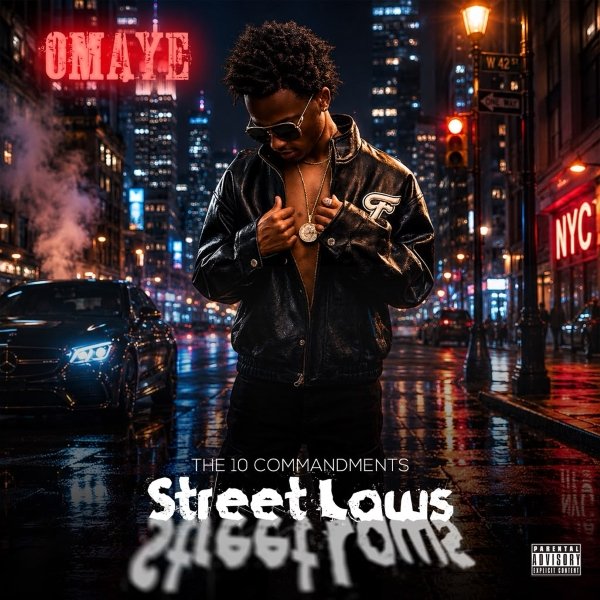
His upcoming debut album, Street Laws, scheduled for release on July 24, 2026, feels less like an introduction than an accumulation.

The tracklist reads almost like someone organizing chapters rather than songs.

Photo Courtesy: OmaYe

Order. Alive. Be Careful. No Fit Resign. Understand. Faith Over Fear. Get Better.

Those aren’t titles built for instant virality. They sound more like reminders someone leaves for themselves.

There’s something quietly revealing about that.

Many debut albums chase attention with spectacle. Bigger hooks. Louder production. Guest appearances carefully selected for playlist placement. The pressure is understandable. Algorithms reward immediacy, not patience.

Street Laws appears to resist that instinct.

Instead, it leans toward continuity. The sequencing hints at movement rather than interruption. Even without hearing every record, the structure suggests someone interested in telling listeners where he’s been before asking them to care about where he’s going.

Perhaps that’s why Seven P feels significant.

The single has already introduced many listeners to OmaYe’s ability to merge Afrobeats, hip-hop, and Amapiano without sounding like he’s assembling trends from a checklist. It moves comfortably, carrying enough melody to stay accessible while avoiding the polished predictability creeping into much of commercial Afrobeats.

Then there was Tell Them.

The song never sounded desperate for approval. That’s unusual.

Emerging artists often perform confidently because they think they’re supposed to. OmaYe’s confidence arrives differently. It’s quieter. Less interested in convincing the audience than in convincing himself.

There’s an important difference between those two things.

Working with producers including PTD, Xavi, Choice D, MC Sameerah, and Strings2Mental has clearly expanded his musical vocabulary. Yet the production rarely overwhelms the person at the center of the records. The beats move. The melodies linger. But the emotional gravity remains anchored in the voice telling the story.

Maybe that’s because he understands something many young artists don’t.

People don’t return to music because everything sounded perfect.

They return because something sounded true.

That may ultimately become OmaYe’s greatest advantage as Afrobeats continues expanding across continents. The genre has become one of the world’s fastest-growing musical movements, but growth creates its own pressures. As commercial expectations increase, artists face a quiet temptation to smooth away the imperfections that made them interesting in the first place.

OmaYe still sounds like someone protecting those imperfections.

There are no warranties waiting on the other side of Street Laws. Debut albums don’t automatically create careers, and streaming numbers rarely tell the whole story anyway.

But there is something increasingly uncommon about an artist who appears willing to let listeners discover him gradually instead of demanding immediate attention.

That may not satisfy the internet’s appetite for overnight success.

It might, however, build something far more durable.

When Street Laws arrives on July 24, 2026, people will inevitably debate the strongest song, the catchiest hook, or the biggest moment.

Those conversations will miss the point.

The real story began years before the album existed.

The music simply caught up.

Connect With OmaYe

Instagram: https://www.instagram.com/omayemusic17

YouTube: https://www.youtube.com/@omayemusic

TikTok: https://www.tiktok.com/@omayemusic

Listen to “Seven P”: https://notnoise.co/link/omaye-seven-p

Leila Ciancaglini Says Agencies Get the Business Backwards, Here’s What She Does Differently

By: Olga Amraie

The founder of RLC Models & Talent Agency on why bookings aren’t the product, sponsorship isn’t transactional, and what it actually takes to build a career that compounds instead of one that just gets gigs.

Ask most modeling or talent agencies what they sell, and the honest answer is bookings. Get the talent in front of a casting director, collect a fee, and move to the next placement. Leila Ciancaglini, founder of RLC Models & Talent Agency, thinks that model is exactly why so many promising careers in fashion and entertainment stall out after a few good years. “A booking is a transaction. A career is a body of work,” she says. “If all you’re doing is stacking transactions, you’re not actually building anything that outlasts the next casting cycle.”

The Problem: Talent Development Treated as an Afterthought

Ciancaglini is direct about what she sees as the industry’s core failure. Most agencies treat development as something that happens incidentally, on the way to the next paid gig, rather than as the actual product being delivered. “The value I’m supposed to be providing isn’t just access to castings,” she says. “It’s positioning, the sustained, strategic work of figuring out what someone’s presence is actually worth and building toward that, instead of taking whatever booking happens to be available this week.”

That distinction between booking and positioning shapes how she runs RLC Models & Talent Agency day to day. Rather than measuring success purely by placement volume, she evaluates whether each opportunity moves a person’s career trajectory forward in a way that compounds. “Some bookings are worth turning down,” she says. “If a placement doesn’t build toward where someone is actually trying to go, taking it just to fill a slot can do more harm than good to how they’re positioned later.”

RLC Backstage: Proof the Model Works

That philosophy recently produced one of the clearest results in Ciancaglini’s career to date: the premiere of RLC Backstage, her docuseries, at the TCL Chinese Theatre as part of Indie Film Festival LA. It’s not a small milestone. The TCL Chinese Theatre is one of the most recognized venues in Hollywood, and a premiere there signals a level of industry credibility that typically takes agencies years to reach.

“RLC Backstage isn’t just a behind-the-scenes show about the agency,” she explains. “It’s proof of the actual argument I’ve been making this whole time, that fashion and talent representation, done with intention, is media in its own right. It extends what the agency does into a much bigger conversation about culture and visibility, not just bookings.”

Photo Courtesy: Oksana Spasiuk

Her Advice for Talent Trying to Build a Career, Not Just a Booking History

Ciancaglini is specific about what she tells the people she represents, and what she’d tell any rising talent trying to break into fashion or entertainment without an agency yet:

Treat every placement as a positioning decision, not just income. “Ask what this booking says about you to the next ten people who see it, not just what it pays,” she says.

Sponsor relationships should never feel transactional. According to Ciancaglini, the partnerships that last are built on genuine alignment and shared values, not a one-time fee for a one-time placement. “The sponsors who stay are the ones who feel like collaborators, not clients,” she says.

Understand fashion as a business from day one. “The people who last in this industry are the ones who treat it like the business it actually is, not just a creative pursuit they happened to fall into,” she says.

Build media presence alongside representation, not instead of it. Ciancaglini points to RLC Backstage as a model for talent and agencies alike: documenting the work itself can become its own asset, separate from any individual booking.

Building Trust as Infrastructure

Pressed on what actually separates agencies that last from ones that burn out their talent and their sponsor relationships within a few cycles, Ciancaglini doesn’t point to connections or budget. “It’s whether people trust that you’re playing the long game with them,” she says. “Talent can tell when they’re being treated as inventory. Sponsors can tell when they’re being treated as a paycheck. The agencies that survive are the ones where both sides believe you’re actually invested in where this goes.”

That trust, she argues, is the real infrastructure behind every successful career in fashion and entertainment, more durable than any single booking, sponsorship, or media placement. “You can lose a booking and recover. You lose trust, and there’s no campaign that fixes that,” she says. “So everything I do is built around protecting that first, even when it means turning down something that looks good short-term.”

Where Fashion, Media, and Opportunity Actually Meet

Ciancaglini’s appearance as a featured guest on Culture X Capital’s pilot episode, “Architecture of Opportunity,” reflects the same thesis she’s built her career around: that fashion, media, and real opportunity aren’t separate worlds requiring separate strategies. “In the right hands, they’re one conversation,” she says. “The agencies and the talent who understand that are the ones who end up building something that actually lasts beyond a single season or a single trend cycle.”

What’s Next

With RLC Backstage extending the agency’s reach well beyond traditional representation work, Ciancaglini is continuing to build out both sides of the business, talent development and media production, as parts of the same long-term strategy rather than separate ventures. For her, the throughline stays consistent: positioning over placement, alignment over transactions, and a career built to compound rather than one that simply accumulates bookings.

https://free.ikesteele.com/culture-x-capital